この記事の要点
たるみの治療で使う機器のエネルギーは、レーザーも超音波も高周波も、すべて皮膚を通ってから深いところへ届きます。厚さ2mmほどの皮膚は、体を守るための壁でもあります。ここが乾いて硬くなっていると、同じ機器で同じ設定を使っても、狙った深さにエネルギーが届きません。
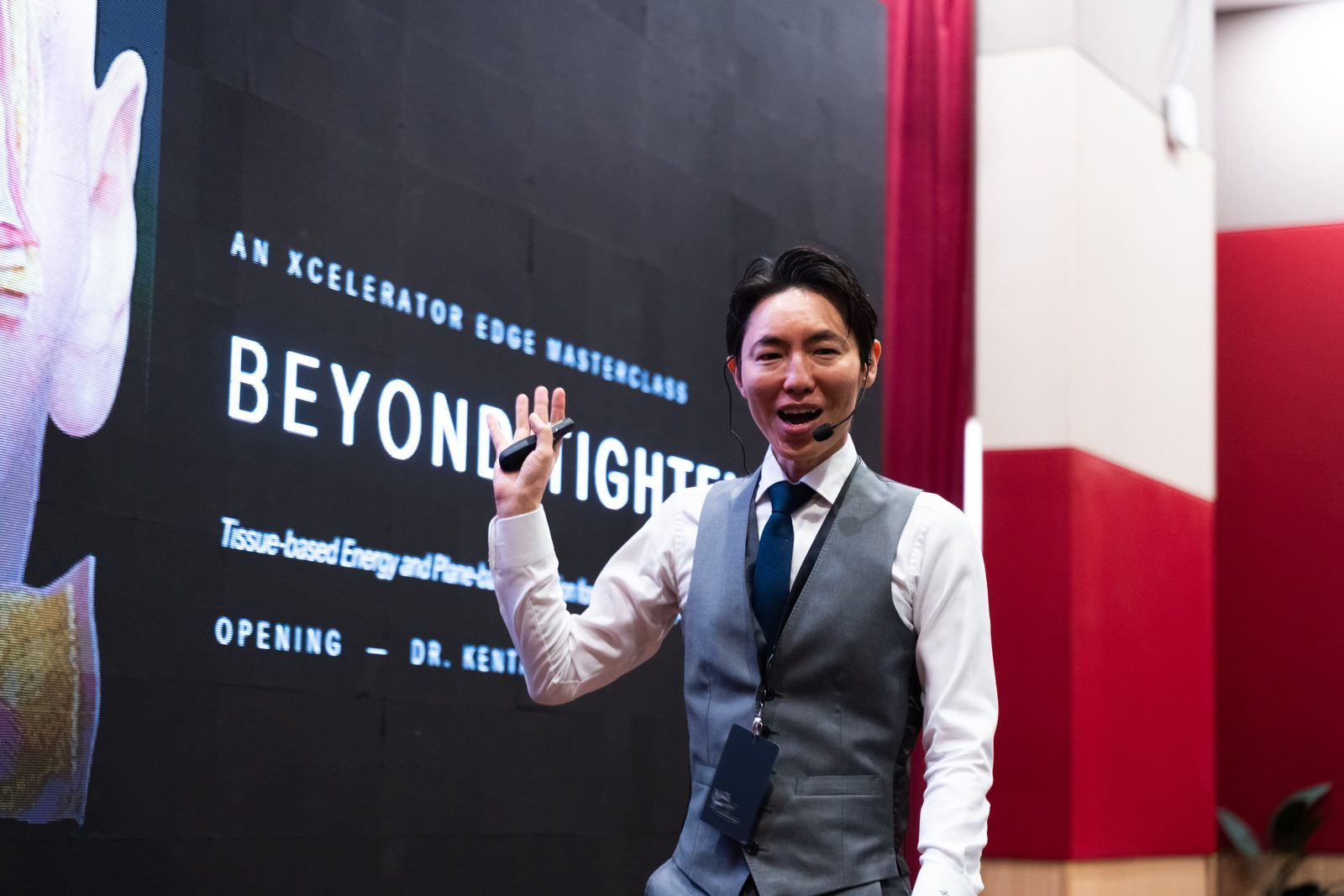
だから私は、たるみ治療で最初にすべきことは肌そのものを整えることだと考えています。入口が整っていれば、強い出力を使わなくても結果は出ます。この考え方を「The Gate Principle(入口の原則)」として、2026年8月30日、マレーシアのプトラ大学で開催された国際セミナー「Beyond Tightening」に講師として登壇し、アジア7つの国と地域から集まった50名を超える医師にお話ししました。この記事では、その内容を患者様に向けて書き直してお伝えします。
はじめに
「年齢と共に、引き締める治療の効果が減ってきた」
以前の私は、その理由を機器や照射の技術の問題として説明していました。いまは違う答え方をします。
変わらなかった原因は、皮膚にあることがほとんどでした。エネルギーは必ず皮膚を通ってから、その下へ届きます。その入口が閉じていれば、どんな機器を使っても奥までは届きません。
1. エネルギーは、すべて皮膚を通っていく
レーザー、超音波、高周波。たるみの治療に使う機器はいろいろありますが、共通していることがあります。体の外から当てる以上、エネルギーは必ず皮膚を通ってから、その下の組織に届くということです。
皮膚の厚さは、顔でおよそ2mm。表皮と真皮という二つの層でできていて、本来の役割は体を守ることです。つまり、外から来るものを通さないための壁です。エネルギーにとっても、皮膚はまず壁として働きます。
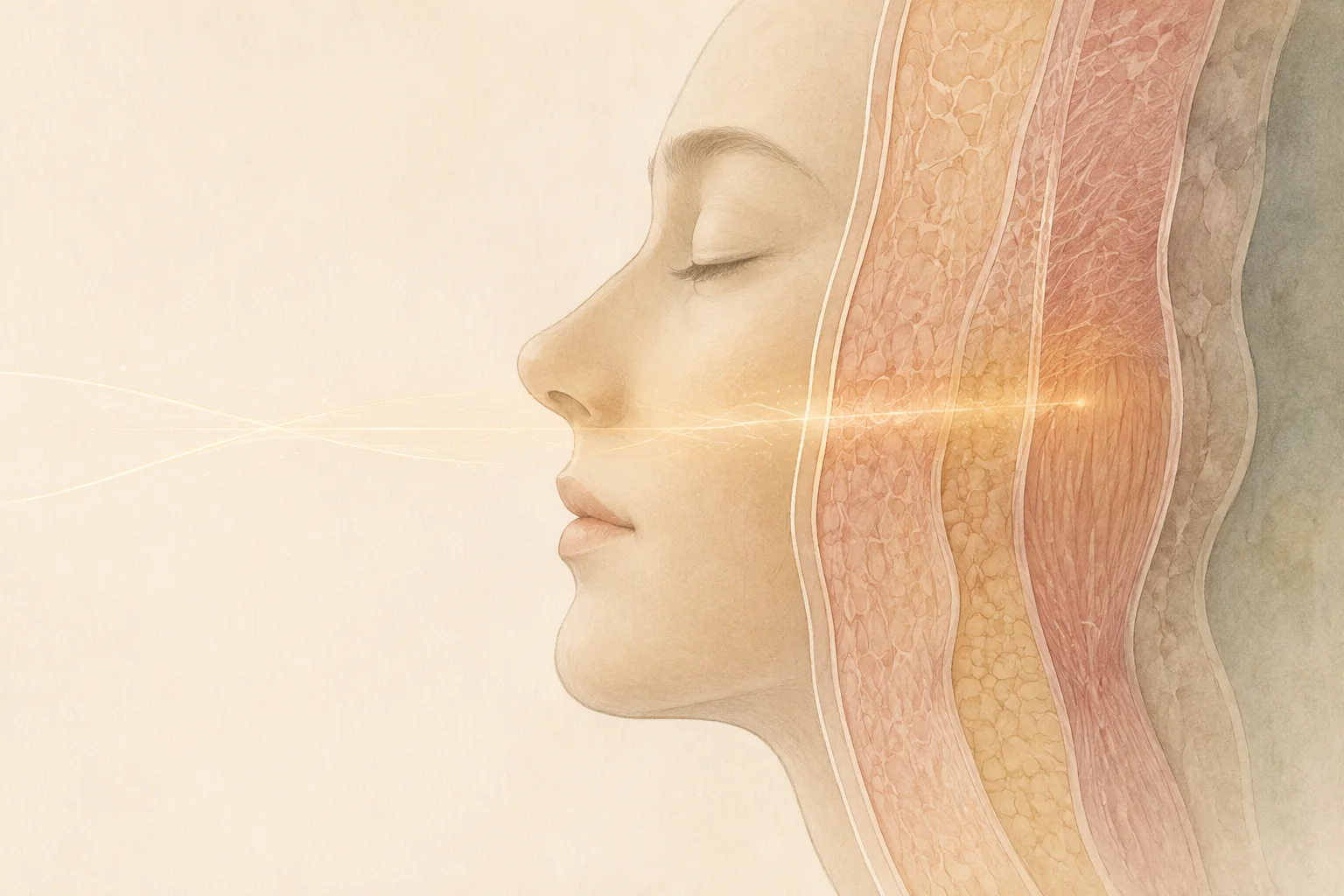
ですから、治療の前にこの壁を、エネルギーが通りやすい状態にしておく必要があります。「入口である肌が整っていなければ、望む結果は手に入らない。逆に入口が整っていれば、弱いエネルギーでも結果を得るのはたやすい」。これが、私がこの日いちばん伝えたかったことです。
2. 乾いた肌に、高周波が効きにくい理由
もう少し具体的にお話しします。機器によって、通りやすい肌の条件が違うからです。
高周波(RF)が狙っているのは、組織の中の水分です。水を伝わって熱が生まれます。ですから乾いて角層が厚くなった肌では、熱が表面近くで発生してしまい、深いところまで届きません。しかも乾いた角層は熱を逃がす力も弱いので、同じ出力なのに冷却が追いつかず、やけどにつながることがあります。
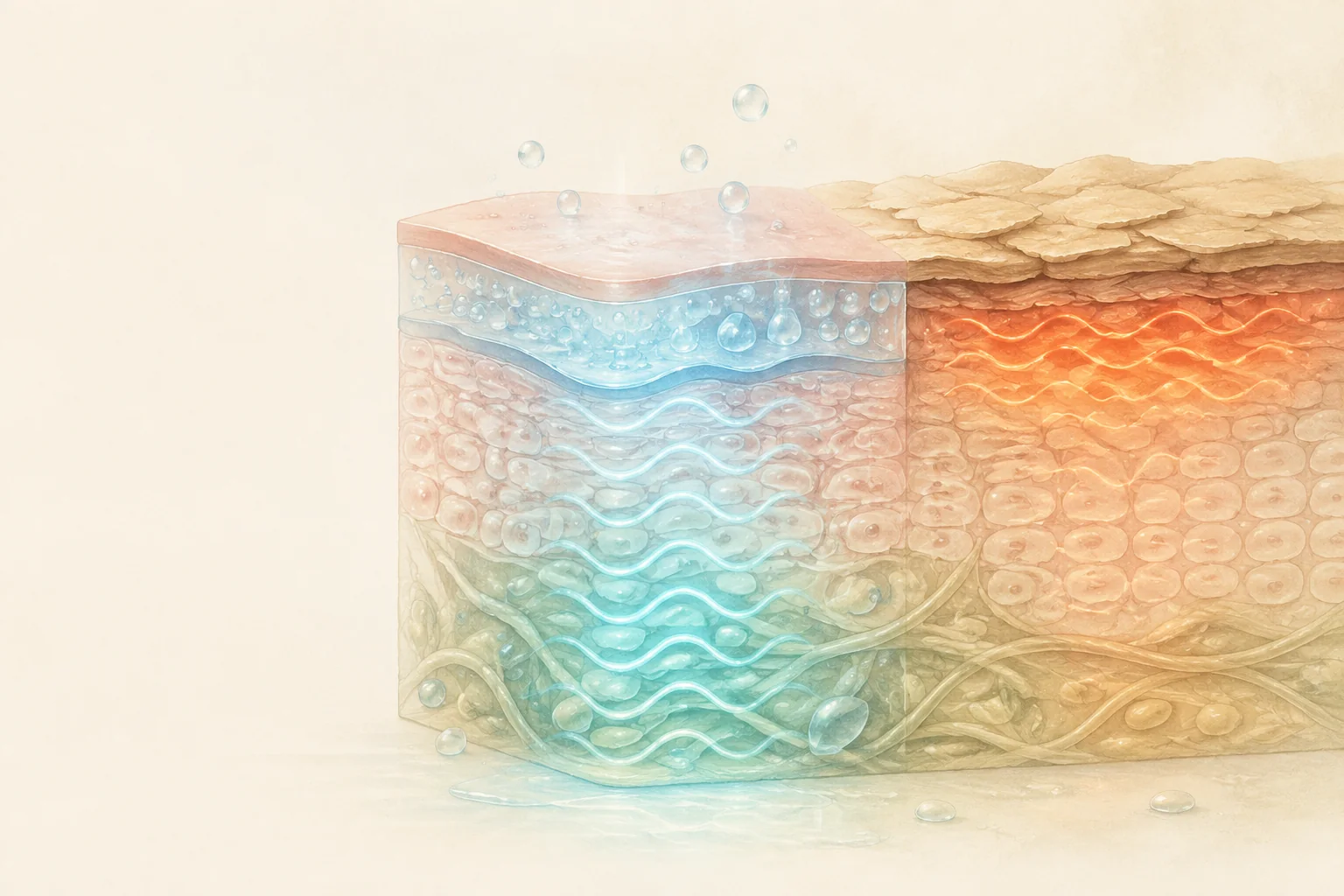
超音波(HIFU)が反応するのは、水ではなくコラーゲンです。こちらは潤っているかどうかではなく、コラーゲンが密に、整った状態で並んでいるかどうかで届き方が変わります。日焼けを重ねた肌では真皮のコラーゲンが変性していて、狙った深さに焦点を結びにくくなります。
効果を出したいときに、同じ場所へ重ねて照射したくなります。しかしこれは逆効果になります。高周波では熱い場所がさらに熱くなり、超音波では手前が熱くなって奥に届かなくなる。頬の脂肪が落ちてこけて見えるという報告は、この重ね打ちと無関係ではありません。
会場では、この違いを一文にして共有しました。高周波は水で伝わる。超音波はコラーゲンで止まる。だから「肌を整える」という言葉の中身も、使う機器によって変わります。
3. だから、たるみ治療には順番がある
ここまでを踏まえると、治療の順番が決まります。
日焼けを重ねてきた肌は水分を失っています。高周波が狙う相手がいない状態です。ですからいきなり高周波から始めるのは、良い選択とは言えません。まずレーザーや超音波で肌の質を整え、4週から8週ほど待ちます。肌が応えられる状態になってから、引き締めの治療に入ります。
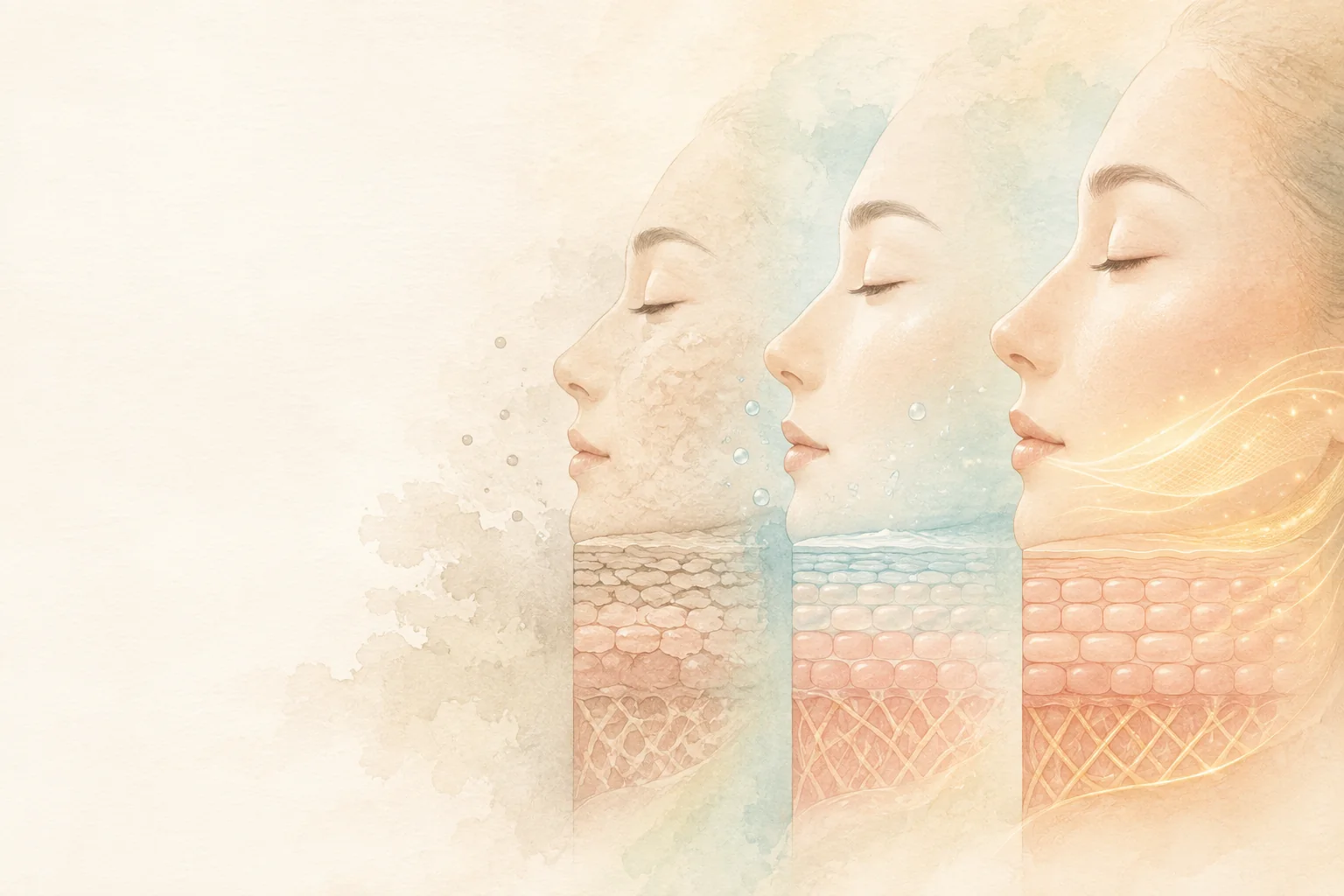
順番を変えるだけで、同じ機器、同じ設定でも結果が変わります。私が診察で治療計画を組み立てるとき、いちばん時間をかけて考えるのはここです。
4. 熱は、細胞を壊すためではなく起こすために使う
もう一つ、機器の使い方そのものについてお話ししました。
細胞に熱を加えたとき、起こることは三つに分かれます。
HEAT AND CELLS
熱の量で、細胞に起きることは変わる
- 1
- 少なすぎる細胞は何も変わりません。治療をしても手応えがない状態です。
- 2
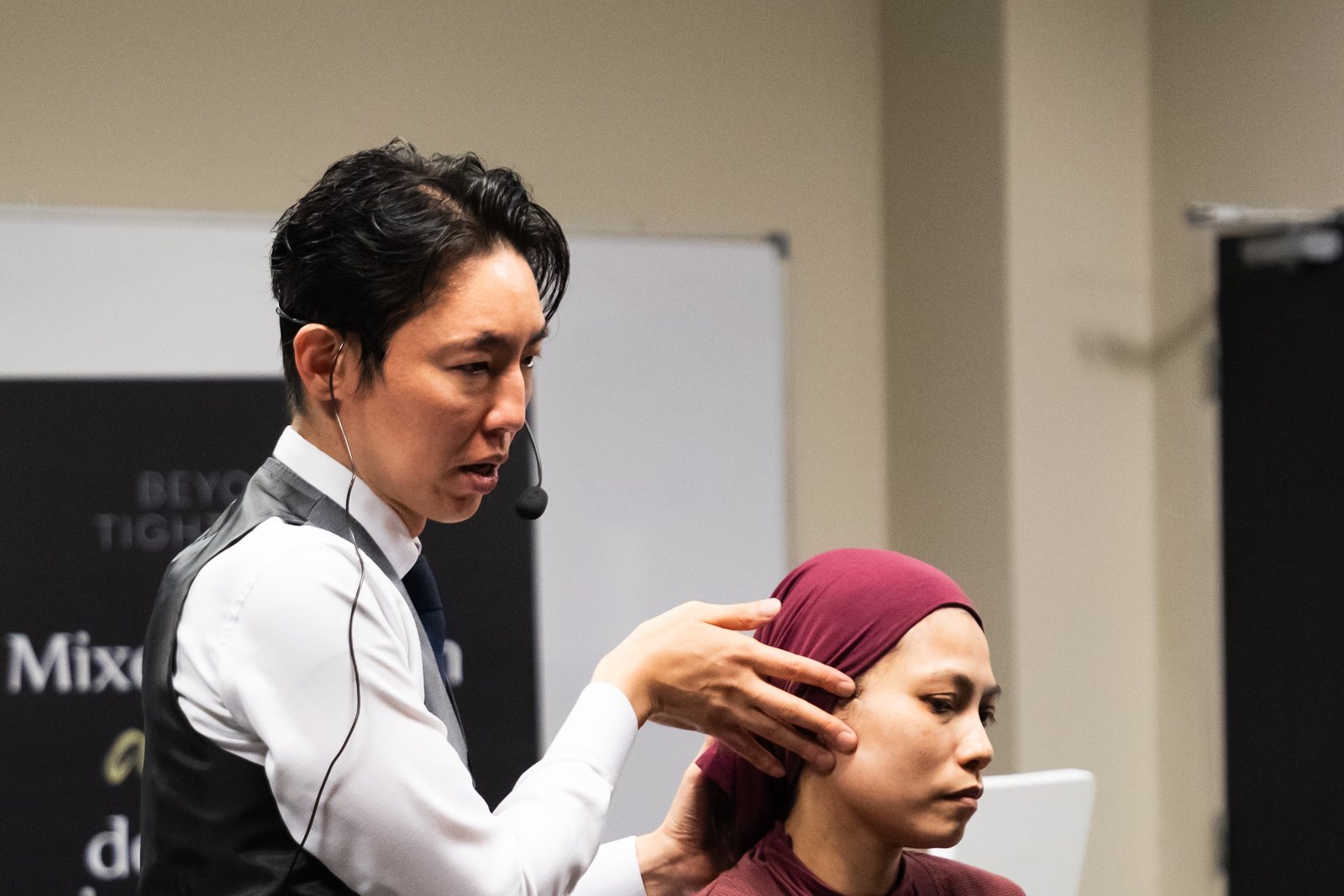
- ちょうどよい細胞の活動が上がり、コラーゲンがつくられ始めます。ここが狙うべき範囲です。
- 3
- 多すぎる細胞の活動が止まり、組織が壊れます。長い目で見ると、肌の力はむしろ落ちます。
言葉にすると当たり前に聞こえます。ところが実際の現場では、三番目を狙って機器が使われていることが少なくありません。しっかり引き締めたい、この組織を減らしたい。そういう気持ちで出力を上げるからです。
私たちが狙うべきなのは、二番目です。強く当てて焦がすことは、その場では効いたように見えても、組織が次に応える力を確実に削ります。
目安になるサインがあります。治療のあとに「肌がくすんだ」「乾燥する」「赤みが引くまで時間がかかった」と感じたときは、エネルギーの入れすぎを疑ってよいと思います。そういう場合は、肝斑の悪化を一緒に起こしていることが多いからです。
5. 診断は、写真の撮り方から始まっている
この日、もう一つ時間をかけて話したのが、臨床写真です。
私たちは診察室で直接お顔を拝見しますが、すべての患者様の状態を正確に記憶しておくことはできません。前回とくらべてどう変わったか、いま行っている治療が合っているかを判断する材料が、写真です。私たちにとって臨床写真は、CTやレントゲンと同じ検査です。
撮影の条件がばらばらなCTが出てきたら、医師は必ず「条件をそろえて撮り直してください」と言います。顔写真もまったく同じです。角度、明るさ、表情。この三つがそろって、はじめて比べられる写真になります。
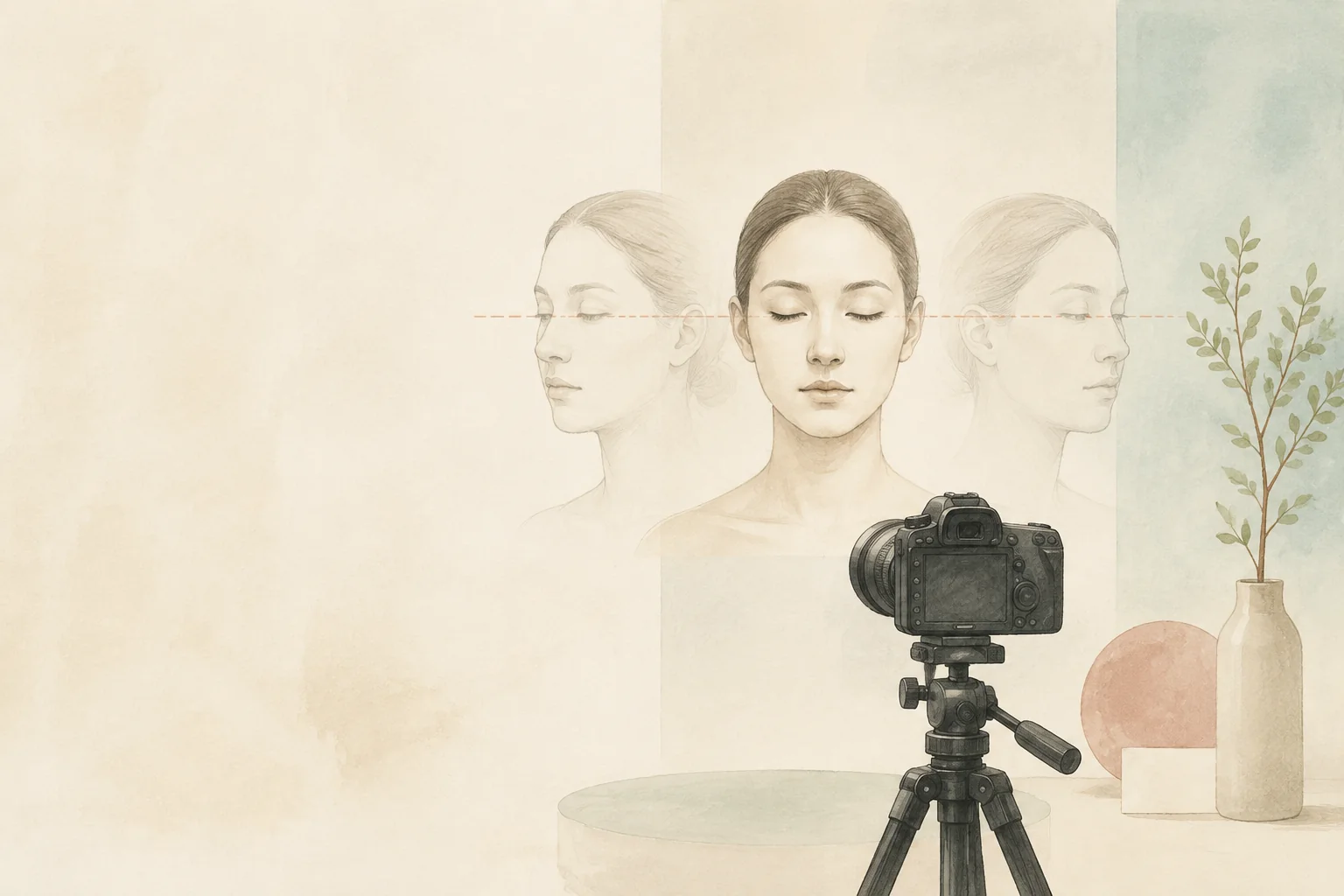
当院では、正面と左右45度の最低3方向を、視線を水平にして撮影します。上目づかいも下向きもいけません。立ったままだと立ち位置がずれるので、回転する椅子に座っていただき、こちらの合図で向きを変えていただきます。カメラはホワイトバランスを合わせ、マニュアルで撮ります。自動モードは、その場その場で最適な絵にすることは得意でも、毎回同じ条件で撮ることは苦手だからです。スマートフォンやタブレットが臨床写真に向かないのも、同じ理由です。
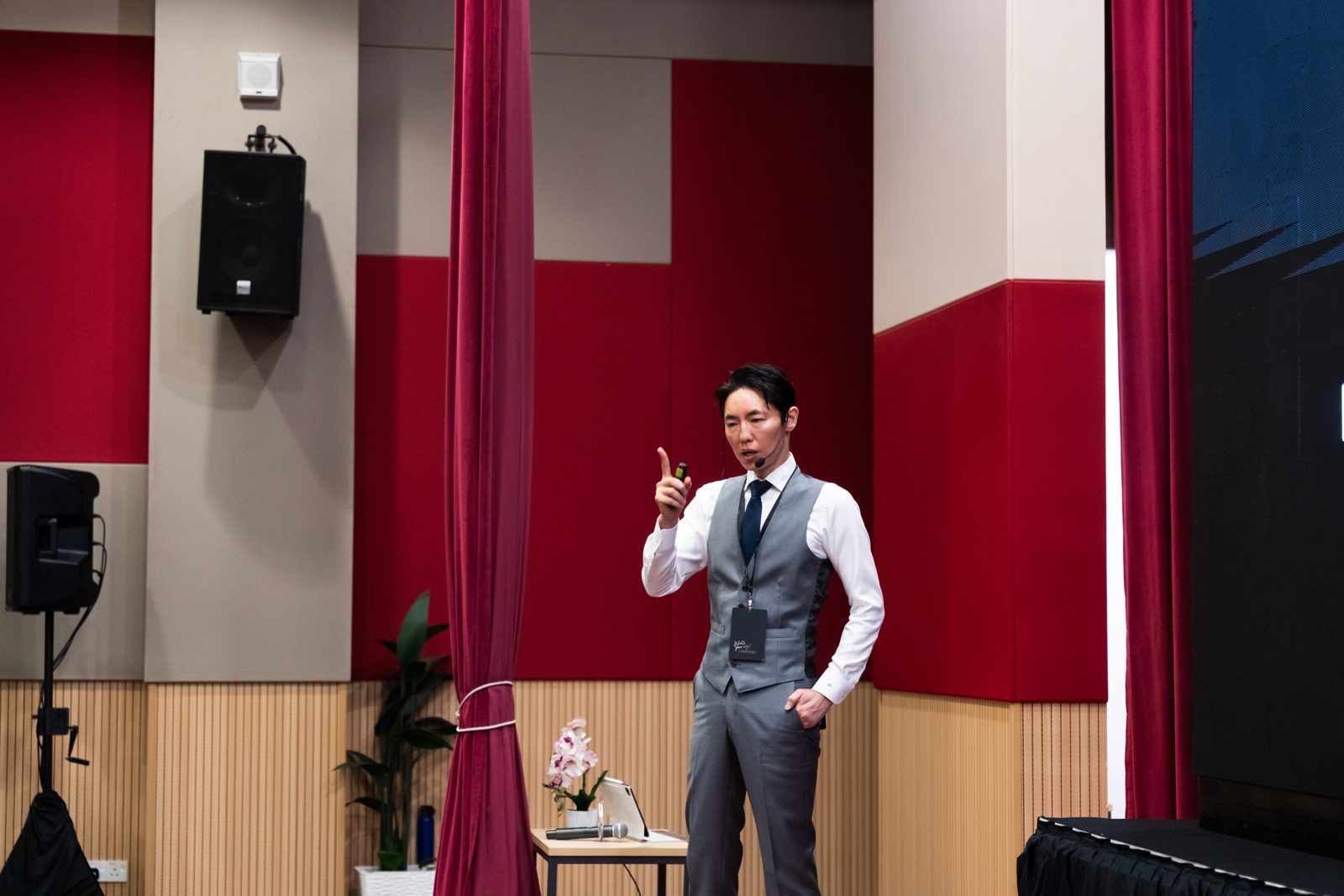
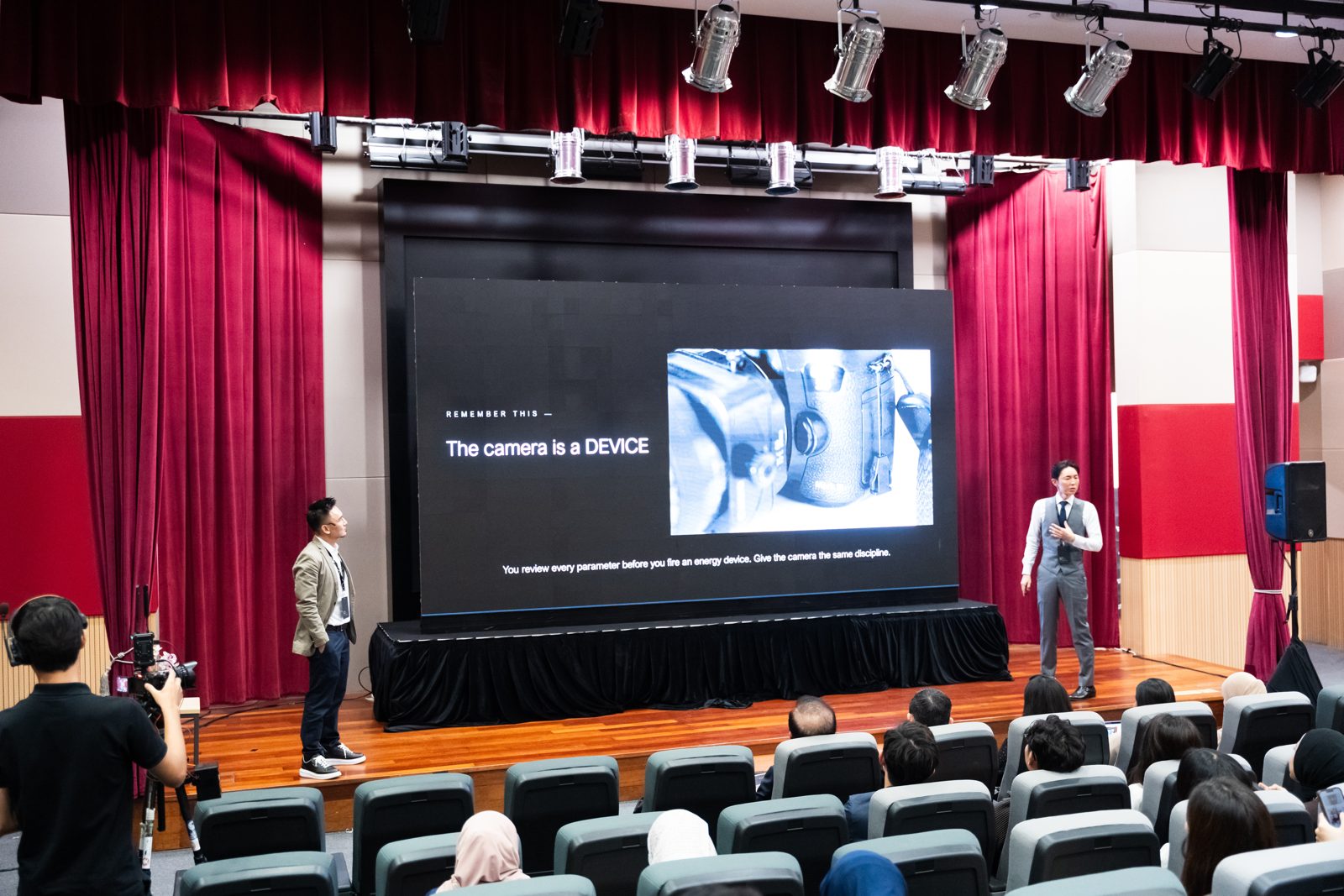
会場のスクリーンには、こう書きました。カメラも一つのデバイスである。照射する前にすべての設定を確認するのと同じ規律を、撮影にも持つ。そう話したとき、会場の医師たちが一斉にメモを取り始めたのが、舞台の上からもよく見えました。
6. 顔は、層で診る
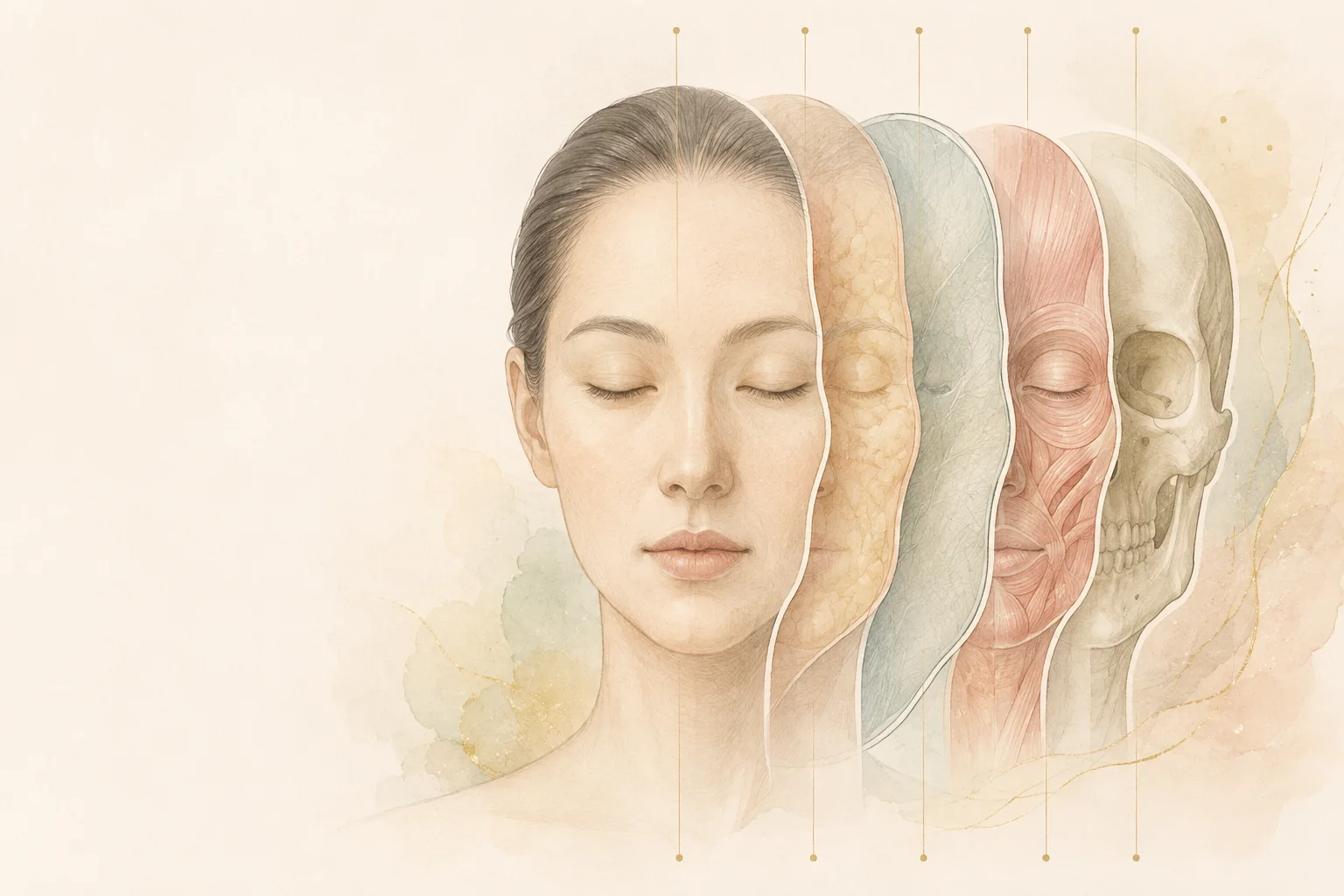
肌が整ったら、次は顔全体のどこに手をかけるかを決めます。顔は、皮膚、皮下の脂肪、その下の膜と筋肉、そして骨という層でできています。大切なのは、どの層にどれだけ配分するかを決めることです。
皮下の脂肪の層には、脂肪そのものだけでなく、脂肪を支える細かい線維が網の目のように走っています。この線維がゆるんで伸びることが、たるみの一因になります。ですから熱を入れるときは、まず全体に、そのあとで支持靭帯(顔を支えている靭帯)の周りに重ねる。この順番を、私は Mono-Bi CrossLIFT Technique® として論文にまとめました。連続して2回、3回と同じ場所に重ねないことが、この方法の要点です。
筋肉の層では、加齢とともに引き上げる筋より引き下げる筋の力が強くなります。そのため、鏡の中の自分が不機嫌に見えるようになります。表情が乏しくなったのではなく、表情の信号がぼやけるのだと考えると分かりやすいと思います。ここは鍛えるのではなく、引き下げる側の力を少しだけ弱めるほうが、自然な印象に戻ります。
骨には、いまのところ機器で働きかける方法がありません。骨の減少を穏やかにしていくには、体の内側からの対策が必要になります。ここは正直にお伝えしています。
この日、注入治療を担当した台湾の Dr. Shangli Lin も、同じ方向から話していました。目の下のたるみ、ほうれい線、口角から下がる線。これらは、顔を支えている構造が失われた結果として現れるということ。だから注入も、膨らませるためではなく、支えを戻すために行うのだということ。層を正しく見分けて、正しい層に届かせる。彼はそれを繰り返し話していました。
私が組織の質を、彼が構造の支えを担当し、最後に一つの治療の順番として組み立て直す。この往復が、この日の中心でした。
7. マレーシアの大学で開催された国際セミナーに登壇して
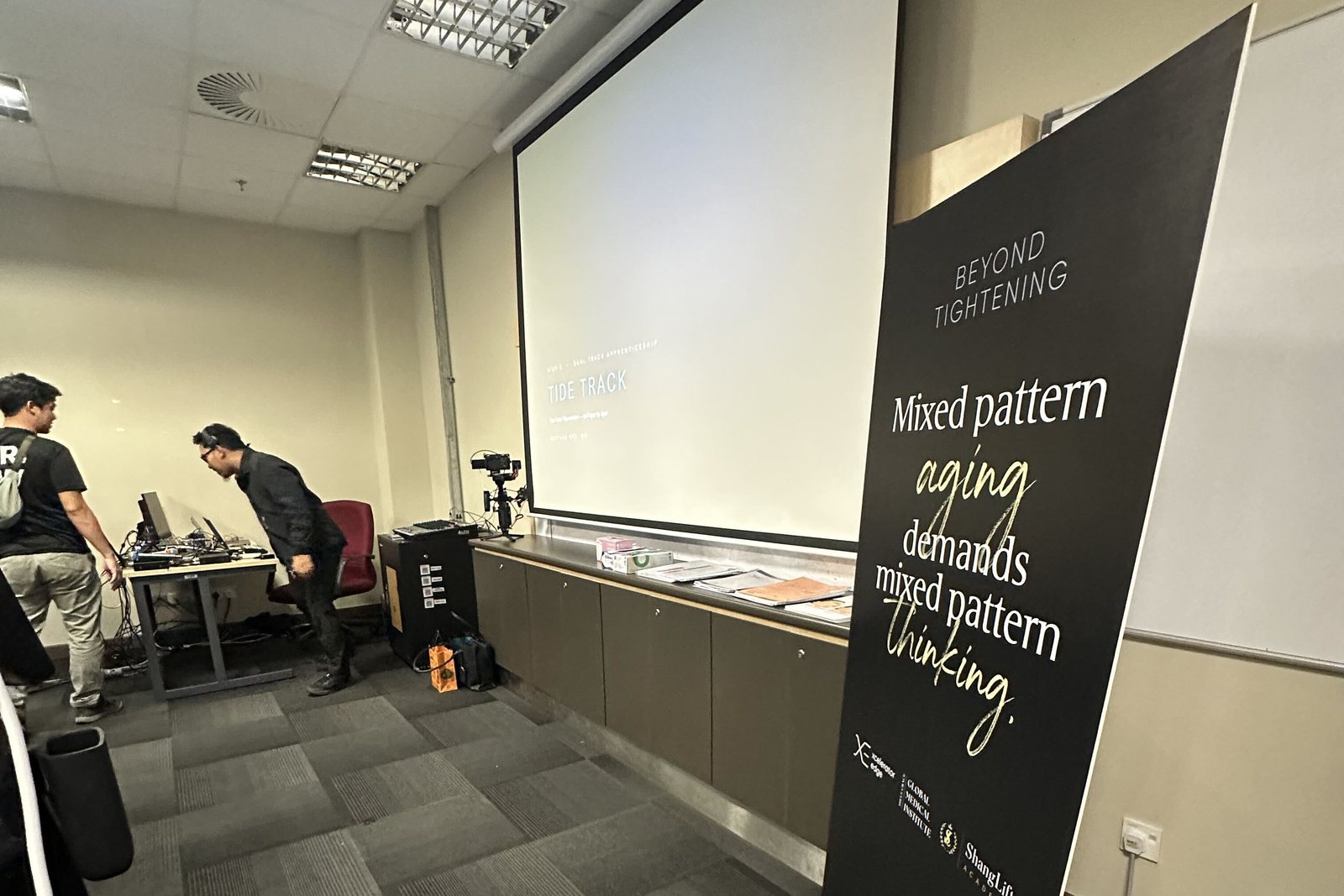
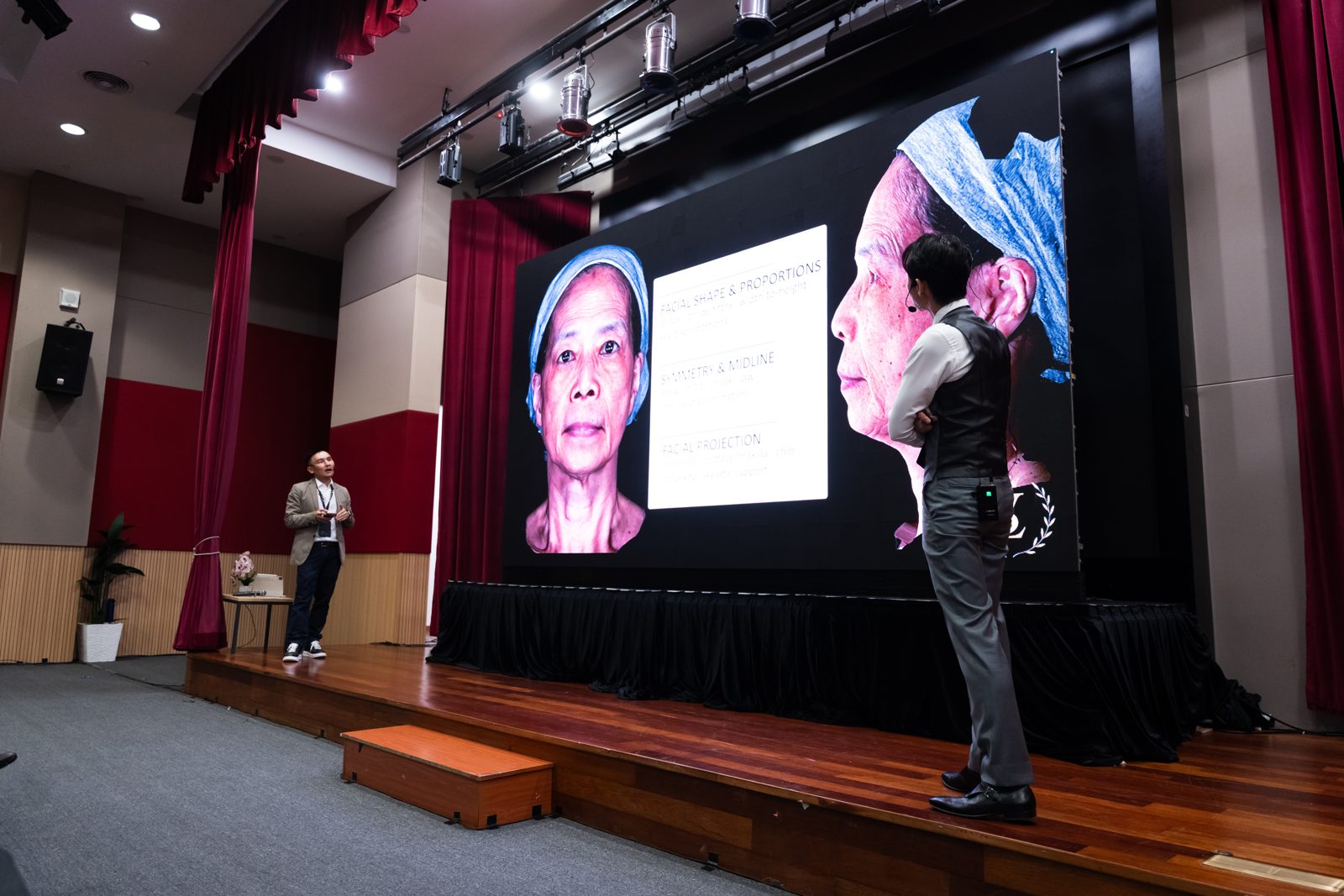
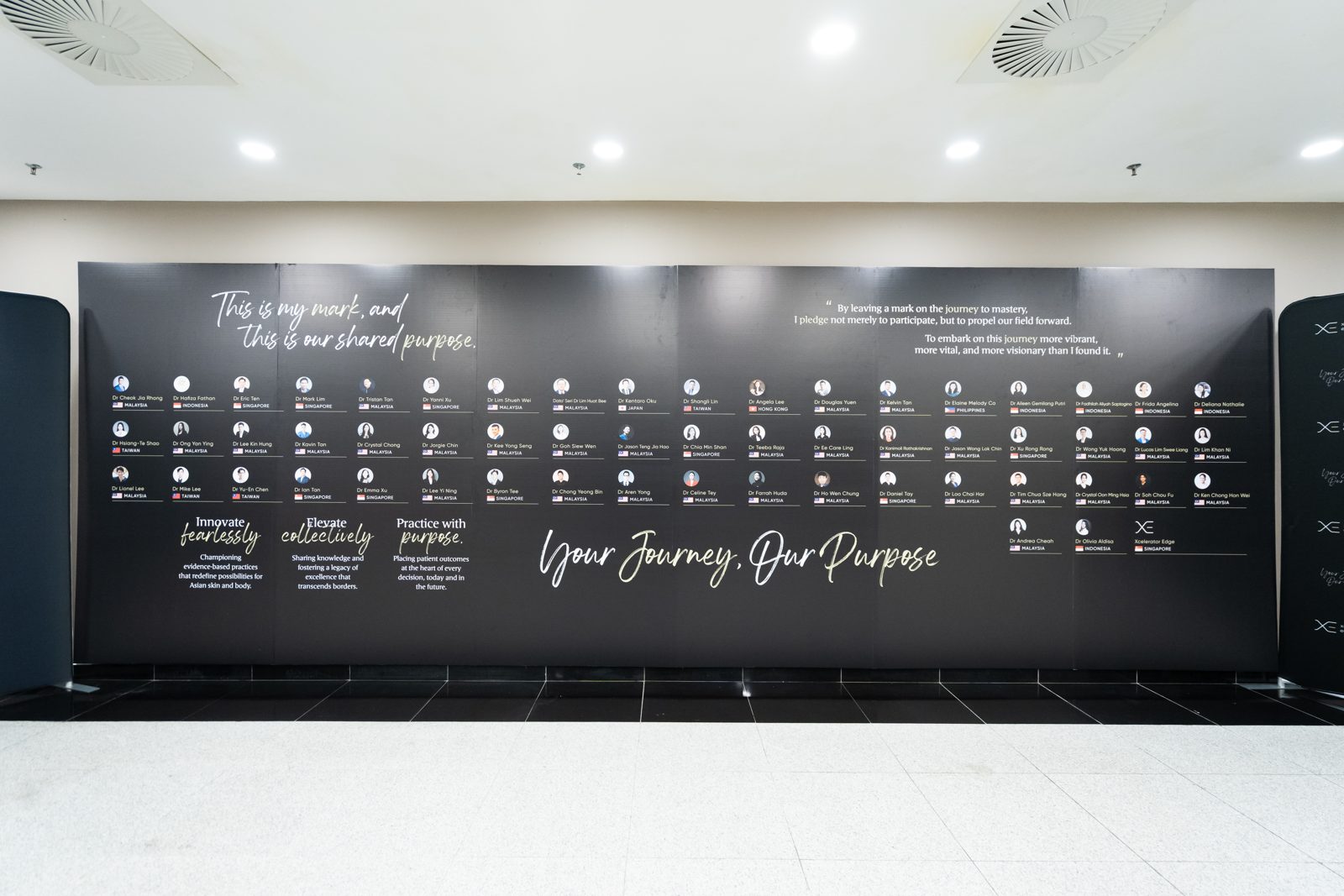
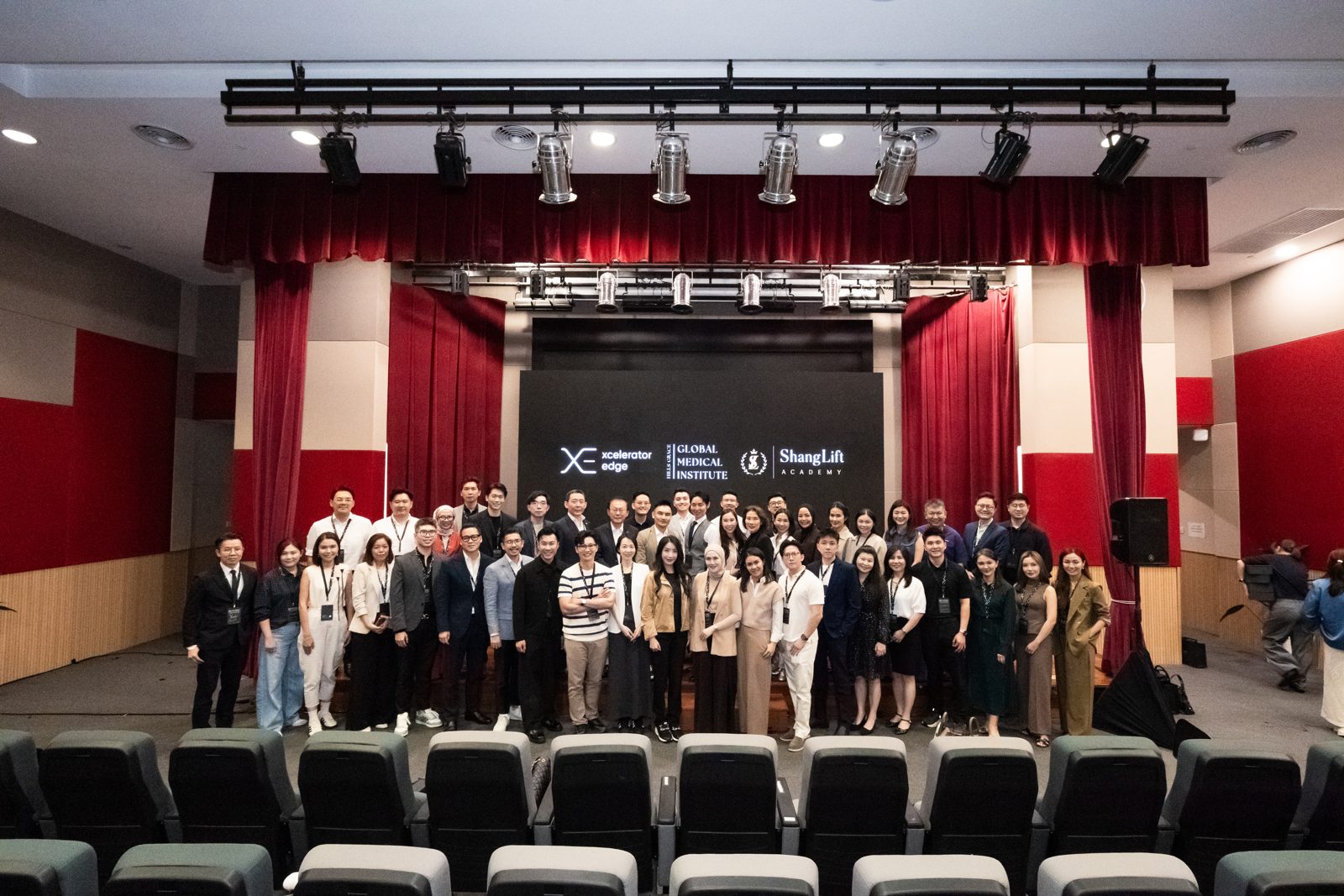
この内容を伝えた場が、マレーシアのプトラ大学で開催された国際セミナー「Beyond Tightening」です。私が設立した Hills Grace Global Medical Institute(GMI)と、Dr. Shangli Lin の ShangLift Academy が、主催の Xcelerator Edge とともに組み立てた一日制のプログラムで、私は講師として登壇しました。
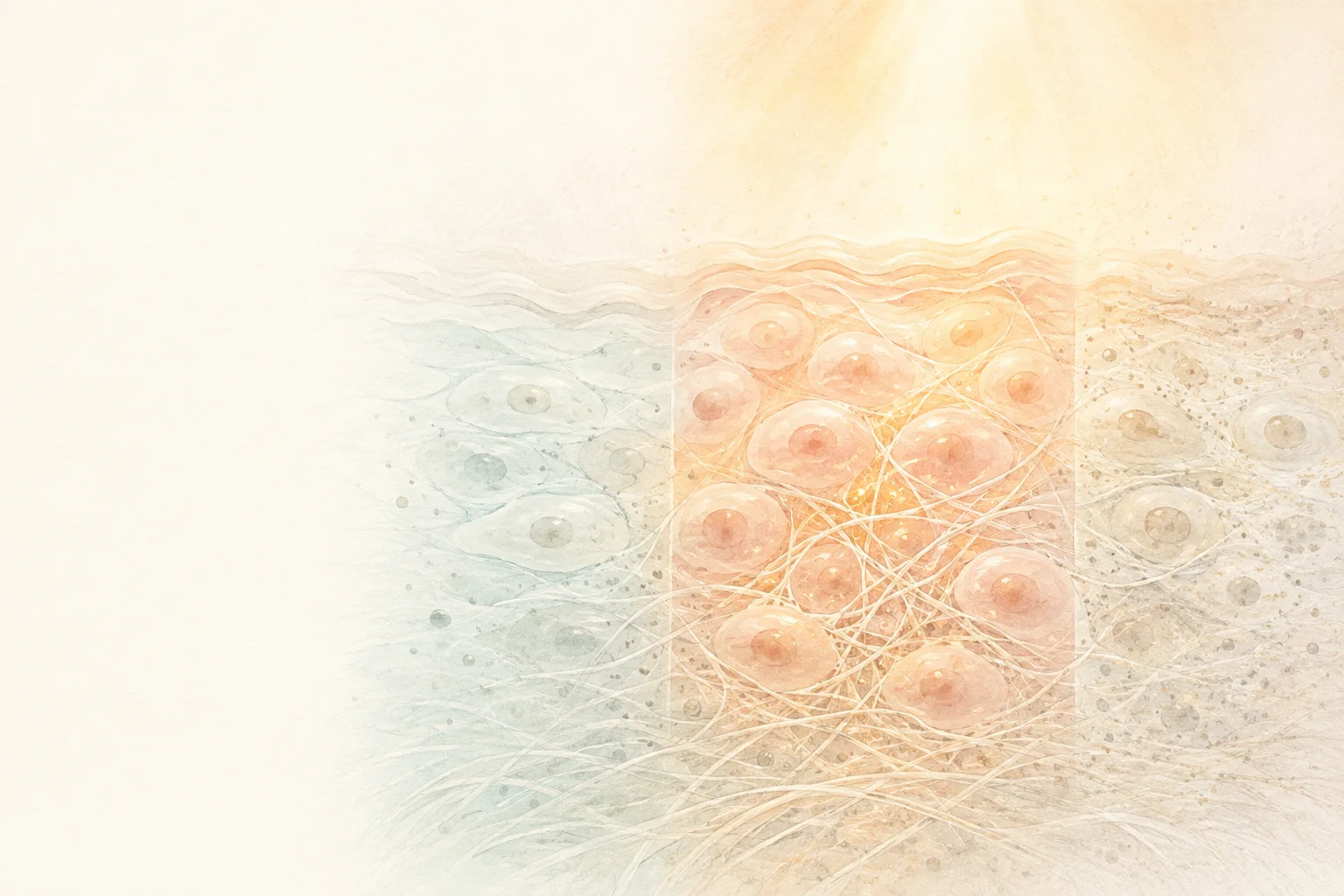
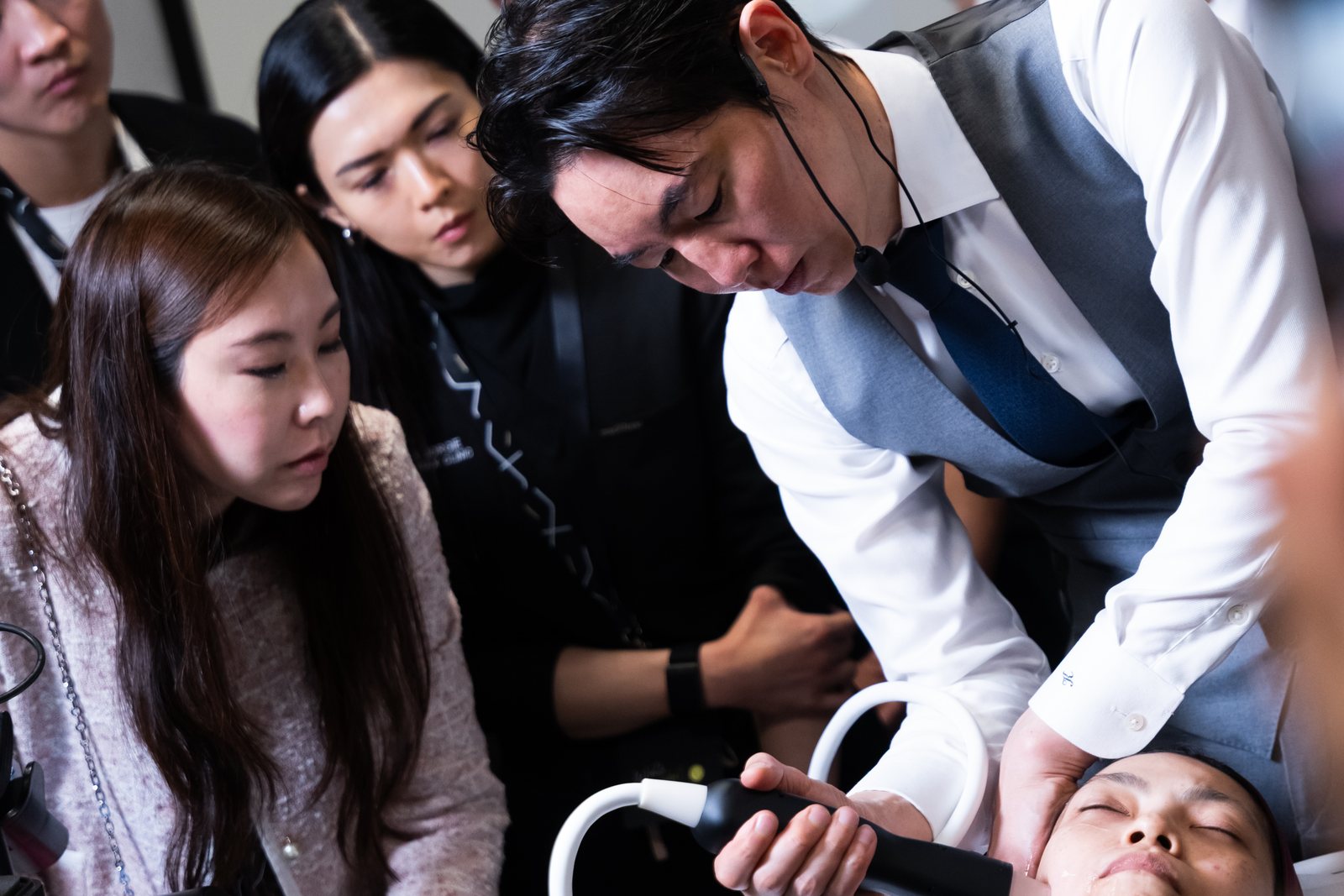
午前は全員で講義、午後は二つの部屋に分かれて実技です。私の部屋では、実際にモデルの方に照射しながら、いま組織のどの層を狙っているのか、なぜここは出力を落とすのか、なぜここは触らないのかを、一手ごとに言葉にしていきました。
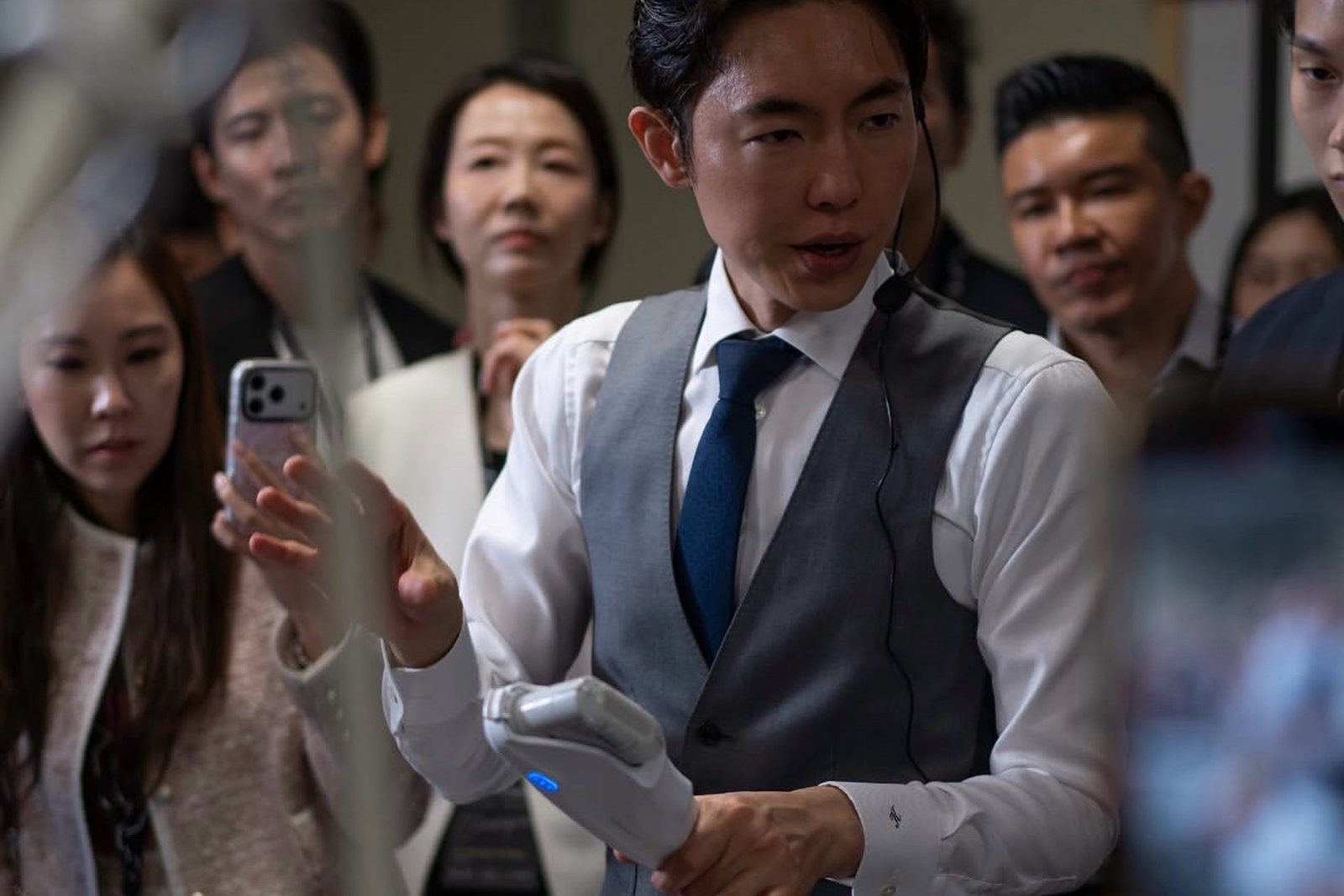
正直に書けば、いちばん苦労したのは手技ではなく、原理を理解してもらうことでした。出力を上げれば結果が良くなるわけではない。細胞が応えられる幅の中で熱を設計する。言葉では頷いていただけます。けれど、長く続けてきた「強く当てる」という習慣は、その場で入れ替わるものではありません。同じ原理を、スライドの一本の線で、手の感触で、照射の一手ごとに、角度を変えて繰り返すしかありませんでした。
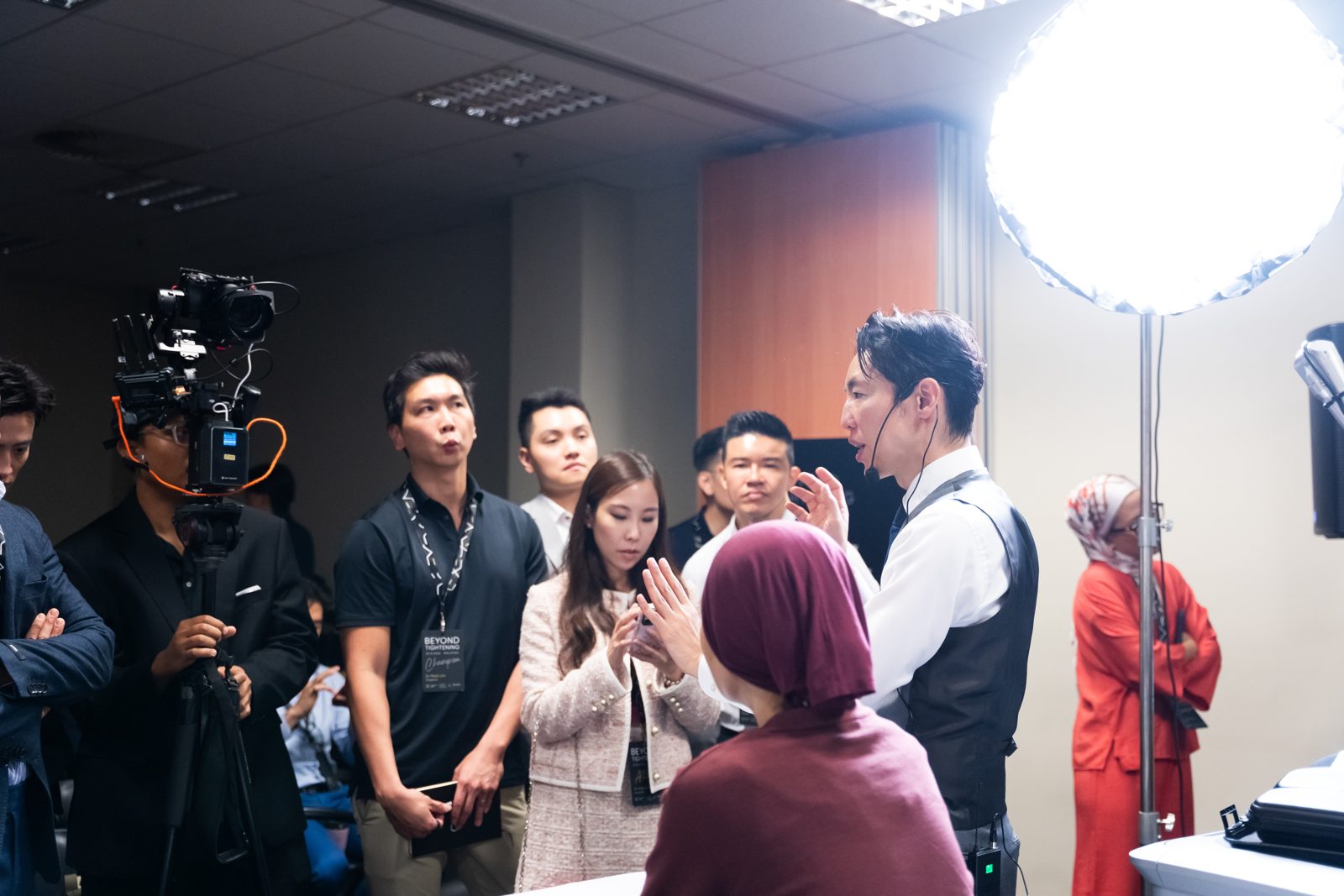
それでも午後の終わりには、部屋の空気が変わっていました。受講する側ではなく、一緒に考える側の顔になっていく。休憩時間の廊下でも、相談が続きました。
おわりに
最後に、患者様にお伝えしたいことが二つあります。
一つは、整えた状態は、放っておくと戻るということです。注入した材料は少しずつ吸収されますし、機器で一度上がった細胞の活性も、3か月ほどかけて下がっていきます。どちらも消耗品だと考えて、続けることを前提に計画を立てるほうが、結果は安定します。
もう一つは、速さについてです。私は診察で「すぐに効果が出ます」とは申し上げません。肌が応えられる状態を整え、順番を守って治療を組み立てると、結果が見えるまでには時間がかかります。そのぶん、戻りにくくなります。
引き締めを重ねても変わらなかった。その経験があるなら、原因は機器ではなく順番にあったのかもしれません。横浜あざみ野の診察室では、そこから一緒に考えます。
よくある質問
引き締める治療を受けたのに、あまり変わりませんでした。なぜでしょうか。
理由はいくつか考えられますが、肌が乾いて硬くなっていると、エネルギーが深いところまで届きにくくなります。この場合は出力を上げるのではなく、先に肌の質を整えてから引き締めの治療に入ると、同じ機器でも届き方が変わります。効果の感じ方には個人差があります。
出力が高いほど、よく効くのですか。
そうとは限りません。細胞が反応できる熱の幅は決まっていて、それを超えると活動が止まり、組織が傷みます。治療後にくすみ、乾燥、長引く赤みを感じた場合は、入れすぎのサインとして診察でご相談ください。
肌を整えてから引き締めるまで、どのくらい待ちますか。
肌の状態によりますが、4週から8週を目安にしています。この期間は何もしないわけではなく、肌質を整える治療やご自宅でのケアを続けていただきます。
骨のやせは、機器の治療で戻せますか。
いまのところ、骨に働きかける機器はありません。骨の減少を穏やかにするには体の内側からの対策が必要で、必要に応じて他科と連携しながらご提案しています。
治療をご検討の方へ
- 効果の程度や持続期間には個人差があります。すべての方に同じ結果が得られることを保証するものではありません。
- エネルギーデバイス治療では、治療後に一時的な赤み・腫れ・熱感・むくみが生じることがあります。まれに水疱・やけど・色素沈着・一時的な神経の違和感などが生じる可能性があります。
- 注入治療では、内出血・腫れ・しこり・左右差などが生じることがあります。まれに血管閉塞などの重い合併症が報告されています。
- 妊娠中・授乳中の方、ペースメーカーなどの体内埋め込み機器を使用されている方、治療部位に金属や糸が入っている方など、治療を受けられない場合があります。診察時に必ずご申告ください。
- 本記事で紹介した治療は自由診療(健康保険が適用されない治療)です。費用はカウンセリング時にご案内しています。
- 本記事は医師向け教育プログラムでの講演内容を、患者様向けに書き直したものです。特定の機器や治療法の効果を保証したり、優劣を示したりするものではありません。
たるみやフェイスラインのお悩みは、横浜あざみ野のヒルズグレイスクリニックまでご相談ください。
いま必要なのは肌を整えることなのか、支えを戻すことなのか。お一人おひとりのお顔を診たうえで、治療の順番からご説明します。
カウンセリングのご相談はこちら →
シミ・肝斑・毛穴など、肌に現れた悩みに向き合うとき、私が大切にしているのは、症状だけでなく、その症状が生じた肌の状態まで見極めることです。
レーザー・高周波・超音波などの機器は、同じ設定で照射しても、結果は一人ひとり異なります。その差を生むのは、肌が熱を受け止め、治療に応えられる状態にあるかどうか。だからこそ、必要に応じて肌が応えられる状態を整えながら、適切な治療を、適切な順序でご提案します。
この考えを治療設計の起点に据え、「Thermal Thread Technique®」として体系化し、2024年に『Lasers in Surgery and Medicine』誌へ発表しました。同論文は同誌のTop Viewed・Top Cited Articleに選出されています。高周波照射法「Mono-Bi CrossLIFT Technique」および、注入治療と医療機器を組み合わせる「CrossTALK® protocol」も『Journal of Cosmetic Dermatology』誌に発表しています。
米国レーザー医学会(ASLMS)専門医、医療法人社団光悠会理事長。Cynosure社のアドバイザリーボードには日本から唯一参加し、PicoSure Proの開発段階から携わり、第1号機による症例報告も行ってきました。世界最大のレーザー医学会ASLMSやIMCAS ASIA、KOREA DERMAなどの国際学会で招待講演を行い、国際的な医師教育プログラム「GMI」を主宰。海外の医師の指導・育成にも取り組んでいます。
これまでの治療で思うような手応えを得られなかった方にも、なぜその肌にその症状が起きているのかを見極め、必要な治療の順序からご提案します。肌を診て、治療を設計し、経過に合わせて組み立てを更新する。そこまでを含めて、肌治療だと考えています。詳しいプロフィール →
CLINIC INFORMATION
ヒルズグレイスクリニック
アクセスの詳細を見る →
肌を整える時間を、診察の外にも。

Key points
The energy of the devices used to treat sagging, whether laser, ultrasound or radiofrequency, always passes through the skin before reaching deeper areas. The skin, about 2 mm thick, is also a wall that protects the body. If it has become dry and hard, the energy does not reach the targeted depth, even with the same device and the same settings.
That is why I believe the first thing to do in sagging treatment is to prepare the skin itself. If the entrance is in good condition, results come even without using high power. Calling this idea “The Gate Principle”, on 30 August 2026 I spoke as a lecturer at the international seminar “Beyond Tightening”, held at Universiti Putra Malaysia, and presented it to more than 50 physicians from seven countries and regions in Asia. In this article, I have rewritten that content for patients.
Introduction
“With age, tightening treatments have become less effective for me.”
In the past, I explained the reason as a matter of the device or of treatment technique. Today I give a different answer.
In most cases, the reason nothing changed lay in the skin. Energy always passes through the skin before reaching what lies beneath it. If that entrance is closed, no device, whatever it is, will reach deep down.
1. All energy passes through the skin
Laser, ultrasound, radiofrequency. There are many kinds of devices used to treat sagging, but they have one thing in common: as long as they are applied from outside the body, the energy always passes through the skin before reaching the tissue beneath it.
On the face, the skin is about 2 mm thick. It consists of two layers, the epidermis and the dermis, and its original role is to protect the body. In other words, it is a wall that keeps out what comes from outside. For energy, too, the skin acts first of all as a wall.
So before treatment, this wall needs to be brought into a state that lets energy pass easily. “If the skin, the entrance, is not in good condition, you cannot get the results you want. Conversely, if the entrance is in good condition, getting results is easy even with weak energy.” This is what I most wanted to convey that day.
2. Why radiofrequency works less well on dry skin
Let me be a little more specific, because the skin conditions that let energy pass easily differ from device to device.
What radiofrequency (RF) targets is the water in the tissue. Heat is generated as it travels through water. So in skin that is dry with a thickened stratum corneum, the heat is generated near the surface and does not reach deep areas. Moreover, a dry stratum corneum is also poor at releasing heat, so even at the same power the cooling cannot keep up, which can lead to burns.
What ultrasound (HIFU) responds to is not water but collagen. Here, how the energy reaches depends not on whether the skin is hydrated but on whether the collagen is densely packed and neatly arranged. In skin with repeated sun exposure, the collagen of the dermis has degenerated, making it harder to focus at the targeted depth.
When you want results, it is tempting to treat the same spot repeatedly. But this is counterproductive. With radiofrequency, the hot spots become even hotter; with ultrasound, the shallower area heats up and the energy no longer reaches deeper. Reports of cheek fat being lost so that the cheeks look hollow are not unrelated to this kind of repeated stacking.
At the venue, I summed up this difference in one sentence. Radiofrequency travels through water. Ultrasound stops at collagen. So what “preparing the skin” actually means also changes depending on the device used.
3. That is why sagging treatment has an order
With all this in mind, the order of treatment follows.
Skin that has been exposed to the sun again and again has lost water. Radiofrequency has nothing to target. So starting straight away with radiofrequency cannot be called a good choice. First, the quality of the skin is prepared with laser or ultrasound, and then we wait about 4 to 8 weeks. Once the skin is in a state where it can respond, we move on to tightening treatment.
Simply changing the order changes the results, even with the same device and the same settings. When I build a treatment plan at a consultation, this is what I spend the most time thinking about.
4. Heat is used to wake cells up, not to destroy them
I also spoke about how the devices themselves are used.
When heat is applied to cells, what happens falls into three categories.
HEAT AND CELLS
The amount of heat changes what happens to cells
- 1
- Too littleNothing changes in the cells. The treatment produces no tangible response.
- 2
- Just rightCell activity increases and collagen begins to be produced. This is the range to aim for.
- 3
- Too muchCell activity stops and the tissue is destroyed. In the long run, the skin’s strength actually declines.
Put into words, this sounds obvious. Yet in actual practice, devices are often used aiming for the third. That is because power is turned up out of a wish to tighten firmly or to reduce this tissue.
What we should aim for is the second. Applying energy strongly enough to scorch may look effective at the time, but it surely erodes the tissue’s ability to respond the next time.
There are signs to watch for. If after treatment you feel that “my skin has become dull”, “it feels dry” or “the redness took a long time to settle”, I think it is reasonable to suspect that too much energy was delivered. In such cases, melasma has often been worsened at the same time.
5. Diagnosis begins with how photographs are taken
Another topic I spent time on that day was clinical photography.
We see patients’ faces directly in the consultation room, but we cannot accurately remember the condition of every patient. Photographs are what we use to judge how things have changed since last time and whether the current treatment is suitable. For us, clinical photographs are an examination, just like a CT scan or an X-ray.
If a CT scan taken under inconsistent conditions came back, a doctor would always say, “Please retake it under the same conditions.” Facial photographs are exactly the same. Angle, lighting and expression: only when these three are consistent do the photographs become comparable.
At our clinic, we take photographs from at least three directions, front and 45 degrees to the left and right, with the gaze level. Looking up or looking down is not acceptable. Standing makes the position shift, so we ask patients to sit on a swivel chair and change direction on our signal. The camera is set to the correct white balance and used in manual mode. This is because automatic mode is good at producing the best-looking image in each moment, but poor at shooting under the same conditions every time. Smartphones and tablets are unsuited to clinical photography for the same reason.
On the screen at the venue, I wrote this: the camera is also a device. Bring to photography the same discipline as checking every setting before treatment. As I said this, I could clearly see from the stage the physicians in the audience all starting to take notes at once.
6. Examining the face in layers
Once the skin is prepared, the next step is to decide where on the face as a whole to work. The face is made up of layers: the skin, the subcutaneous fat, the membranes and muscles beneath it, and the bone. What matters is deciding how much to allocate to each layer.
In the subcutaneous fat layer, there is not only the fat itself but also a mesh-like network of fine fibres supporting it. The loosening and stretching of these fibres is one cause of sagging. So when heat is delivered, it is applied first over the whole area, and then layered around the retaining ligaments (the ligaments that support the face). I set out this order in a paper as the Mono-Bi CrossLIFT Technique®. The key point of this method is not to stack passes on the same spot two or three times in a row.
In the muscle layer, with age the muscles that pull down become stronger than those that lift. As a result, the person in the mirror starts to look displeased. I think it is easier to understand if you think of it not as expressions becoming poorer, but as the signals of expression becoming blurred. Here, rather than strengthening, slightly weakening the pulling-down side restores a natural impression.
For bone, there is at present no way to act on it with devices. Slowing bone loss requires measures from inside the body. I tell patients this honestly.
Dr. Shangli Lin from Taiwan, who was in charge of injectable treatment that day, spoke from the same direction. Under-eye sagging, nasolabial folds and the lines running down from the corners of the mouth appear as a result of the loss of the structures that support the face. So injections, too, are given not to add volume but to restore support. Distinguish the layers correctly and reach the correct layer. He repeated this again and again.
I took charge of tissue quality, he took charge of structural support, and in the end we rebuilt it all as a single treatment sequence. This back-and-forth was the heart of the day.
7. Speaking at an international seminar held at a Malaysian university
The occasion where I presented this content was the international seminar “Beyond Tightening”, held at Universiti Putra Malaysia. It was a one-day programme put together by Hills Grace Global Medical Institute (GMI), which I founded, and Dr. Shangli Lin’s ShangLift Academy, together with the organiser Xcelerator Edge, and I spoke as a lecturer.
The morning was lectures for everyone, and in the afternoon we split into two rooms for hands-on sessions. In my room, while actually treating models, I put into words, move by move, which layer of tissue I was targeting at that moment, why I lowered the power here, and why I did not touch this area.
To be honest, the hardest part was not the technique but getting the principles understood. Turning up the power does not mean better results. Heat is designed within the range in which cells can respond. In words, people nod in agreement. But the long-held habit of “applying it strongly” is not something that changes on the spot. All I could do was repeat the same principle from different angles: with a single line on a slide, with the feel of the hands, with each move of the treatment.
Even so, by the end of the afternoon the atmosphere in the room had changed. Their faces became those of people thinking together with us rather than people attending a course. Even in the corridors during breaks, the discussions continued.
In closing
Finally, there are two things I would like to tell patients.
The first is that a prepared condition reverts if left alone. Injected materials are gradually absorbed, and cell activity once raised by a device also declines over about 3 months. Results are more stable if you think of both as consumables and plan on the assumption of continuing.
The second concerns speed. At consultations, I do not say, “You will see results straight away.” When the skin is brought into a state where it can respond and treatment is built while keeping to the order, it takes time before results become visible. In return, they are less likely to revert.
Repeated tightening made no difference. If that has been your experience, the cause may have lain not in the device but in the order. In our consultation room in Azamino, Yokohama, we think it through together from there.
Frequently asked questions
I had a tightening treatment, but not much changed. Why?
Several reasons are possible, but if the skin is dry and hard, energy has difficulty reaching deep areas. In this case, rather than raising the power, preparing the quality of the skin first and then moving on to tightening treatment changes how the energy reaches, even with the same device. How effects are felt varies between individuals.
Does higher power mean better results?
Not necessarily. There is a set range of heat to which cells can respond, and beyond it their activity stops and the tissue is damaged. If you notice dullness, dryness or prolonged redness after treatment, please consult us at a consultation, as this may be a sign that too much was delivered.
How long is the wait between preparing the skin and tightening?
It depends on the condition of the skin, but we use 4 to 8 weeks as a guide. This period does not mean doing nothing; we ask patients to continue treatments that prepare skin quality and their care at home.
Can bone thinning be reversed with device treatment?
At present, there is no device that acts on bone. Slowing bone loss requires measures from inside the body, and we make suggestions in cooperation with other departments where necessary.
For those considering treatment
- The degree and duration of effects vary between individuals. We do not guarantee that everyone will obtain the same results.
- With energy-based device treatment, temporary redness, swelling, a sensation of heat and oedema may occur after treatment. Rarely, blisters, burns, pigmentation, temporary abnormal nerve sensations and similar effects may occur.
- With injectable treatment, bruising, swelling, lumps, asymmetry and similar effects may occur. Rarely, serious complications such as vascular occlusion have been reported.
- Treatment may not be possible for people who are pregnant or breastfeeding, who use implanted devices such as pacemakers, or who have metal or threads in the treatment area, among others. Please be sure to tell us at the consultation.
- The treatments described in this article are private, self-funded care (not covered by health insurance). Fees are explained at the counselling consultation.
- This article is a rewritten version, for patients, of a lecture given at an educational programme for physicians. It does not guarantee the effects of any specific device or treatment method, nor does it indicate that any is superior or inferior.
For concerns about sagging or the facial contour, please consult Hills Grace Clinic in Azamino, Yokohama.
Is what you need now to prepare the skin, or to restore support? After examining each person’s face, we explain starting from the order of treatment.
Enquire about a counselling consultation →
When addressing concerns that appear on the skin, such as pigmentation, melasma and pores, what I value is assessing not only the symptoms but also the condition of the skin in which those symptoms arose.
With devices such as laser, radiofrequency and ultrasound, results differ from person to person even when the same settings are used. What creates that difference is whether the skin is in a state where it can receive heat and respond to treatment. That is why, while preparing the skin so that it can respond where necessary, I suggest the appropriate treatment in the appropriate order.
Placing this idea at the starting point of treatment design, I systematised it as the “Thermal Thread Technique®” and published it in 2024 in “Lasers in Surgery and Medicine”. The paper has been selected as a Top Viewed and Top Cited Article in the journal. I have also published the radiofrequency treatment method “Mono-Bi CrossLIFT Technique” and the “CrossTALK® protocol”, which combines injectable treatment with medical devices, in the “Journal of Cosmetic Dermatology”.
I am a specialist of the American Society for Laser Medicine and Surgery (ASLMS) and Chair of the Board of Koyukai Medical Corporation. I am the only member from Japan on Cynosure’s advisory board, have been involved with PicoSure Pro since its development stage, and have reported cases treated with the first unit. I have given invited lectures at international congresses such as ASLMS, the world’s largest society for laser medicine, IMCAS ASIA and KOREA DERMA, and I lead the international physician education programme “GMI”. I am also engaged in teaching and training physicians from overseas.
Even for those who have not felt the response they hoped for from previous treatments, I assess why that skin has that symptom and suggest the treatment starting from the order that is needed. Examining the skin, designing the treatment, and updating the plan as it progresses: I consider all of this to be skin treatment. Full profile →
CLINIC INFORMATION
Hills Grace Clinic
Access details →
Caring for your skin beyond the consultation room
HOME CARE
Online shop
Doctor-selected skincare and supplements, delivered to your home. For some products, a free online consultation is available before purchase.
CONSULTATION
Consult us at the clinic
Every person's skin is different. We look into what lies behind pigmentation and melasma, and suggest the care and the order of treatment your skin needs now.