駅の階段を下りきったところで、くしゃみがひとつ。
「あ」と思う。ほんの少しだけれど、たしかに。そのあとは何ごともなかったように、また歩き出す。
この話を、誰かにしたことはありますか。ほとんどの方が、一度もありません。
この記事の要点
くしゃみや咳で少し漏れるのは、我慢が足りないからでも、年のせいでもありません。骨盤の底で臓器を支えている骨盤底筋が、出産と閉経という二つの出来事で変化するからです。そして、ここからが大事なところです。骨盤底筋は、鍛えれば変わることが確かめられている筋肉です。ただし、口頭の説明だけで始めた場合、正しく動かせていたのは約半数だったという報告もあります。知ってから始める。それが、遠回りに見えていちばんの近道です。
1|骨盤の底で、臓器を支えている「ハンモック」
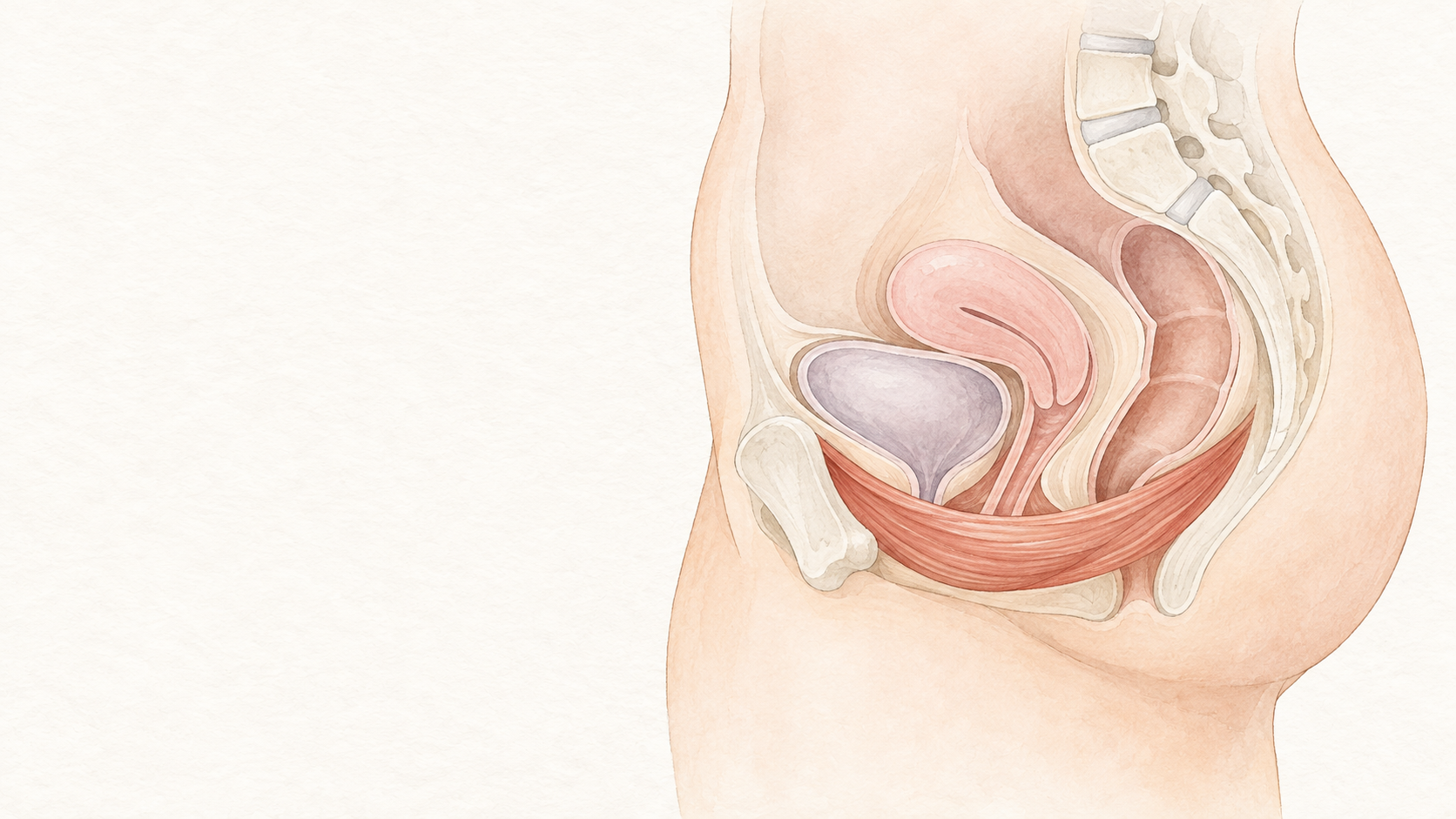
骨盤底筋は、骨盤の底に張られた筋肉の層です。膀胱、子宮、腸を、下からハンモックのように支えています。
この筋肉のすごいところは、一日中、休まず働いていることです。立っているとき、笑うとき、重い荷物を持ち上げるとき。お腹に圧がかかるたびに、内臓が下へ落ちないよう、下から受け止めています。呼吸のたびに横隔膜と連動して、上下にゆっくり動いてもいます。
けれど、この筋肉は鏡で見えません。腕の筋肉なら、力を入れれば盛り上がるのが見えます。お腹なら、触ればわかります。骨盤底筋だけは、動いているかどうかを、自分の感覚以外に確かめる方法がありません。
見えないから、気づかない。気づかないから、変わっていく途中に手を打てない。この記事は、その「見えなさ」を埋めるために書きました。
2|出産と閉経。骨盤底筋が変わる二つの理由
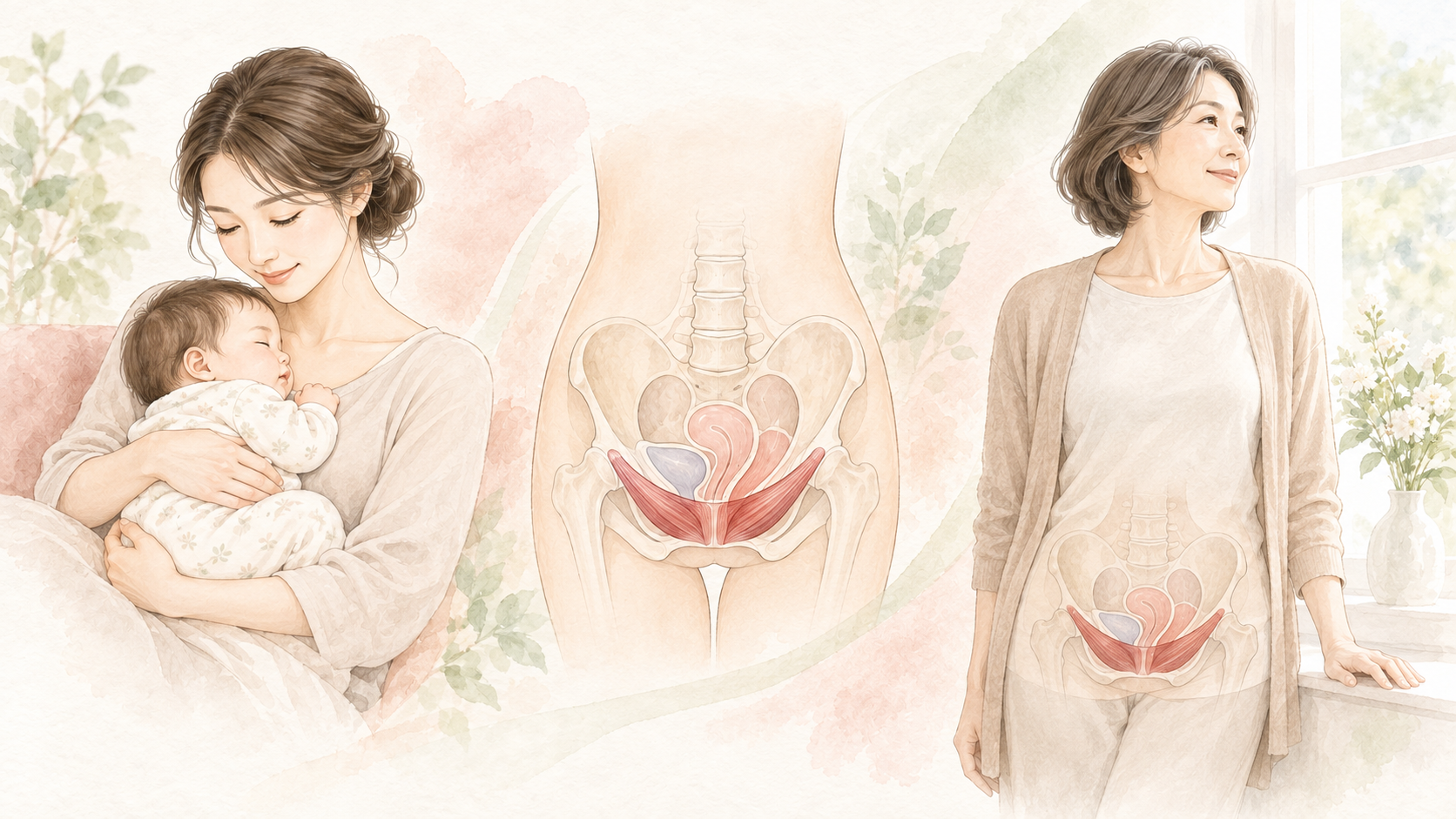
骨盤底筋がゆるむ原因は、意志の弱さでも、運動不足だけでもありません。研究で繰り返し確かめられている、はっきりした要因があります。
ひとつめ:出産
経腟分娩は、60歳未満の女性における骨盤底機能障害の、最も強いリスク因子のひとつとして報告されています。多産や、分娩時の会陰裂傷も、長期的な骨盤底の症状に関連すると考えられています。
赤ちゃんが通るとき、骨盤底筋とその周りの神経は、これ以上ないほど引き伸ばされます。多くは時間とともに回復していきますが、出産前とまったく同じに戻るとはかぎりません。それは、体が壊れたということではなく、大きな仕事をした跡です。
Risk factors for pelvic floor dysfunction. In: StatPearls / NCBI Bookshelf.(全文)
ふたつめ:閉経
もうひとつが、閉経です。
骨盤を支える組織には、コラーゲンの合成と分解を調整するエストロゲン受容体があります。閉経でエストロゲンが下がると、筋肉が細くなり、支えているコラーゲンも減っていきます。ハンモックの布地そのものが、少しずつ薄くなっていくようなイメージです。
閉経後の女性では、最大で約4割に、何らかの骨盤底の不調がみられると推定する報告もあります。
Pelvic floor dysfunction—Does menopause duration matter? Maturitas. 2013./Local Oestrogen for Pelvic Floor Disorders: A Systematic Review. PLOS ONE. 2015.
このほか、肥満、慢性的な便秘、長く続く咳など、お腹に繰り返し圧がかかる状態も、骨盤底への負担を積み重ねる要因として挙げられています。便秘を整えることは、骨盤底のケアでもあります。
3|「年のせい」で片づけられてきたこと
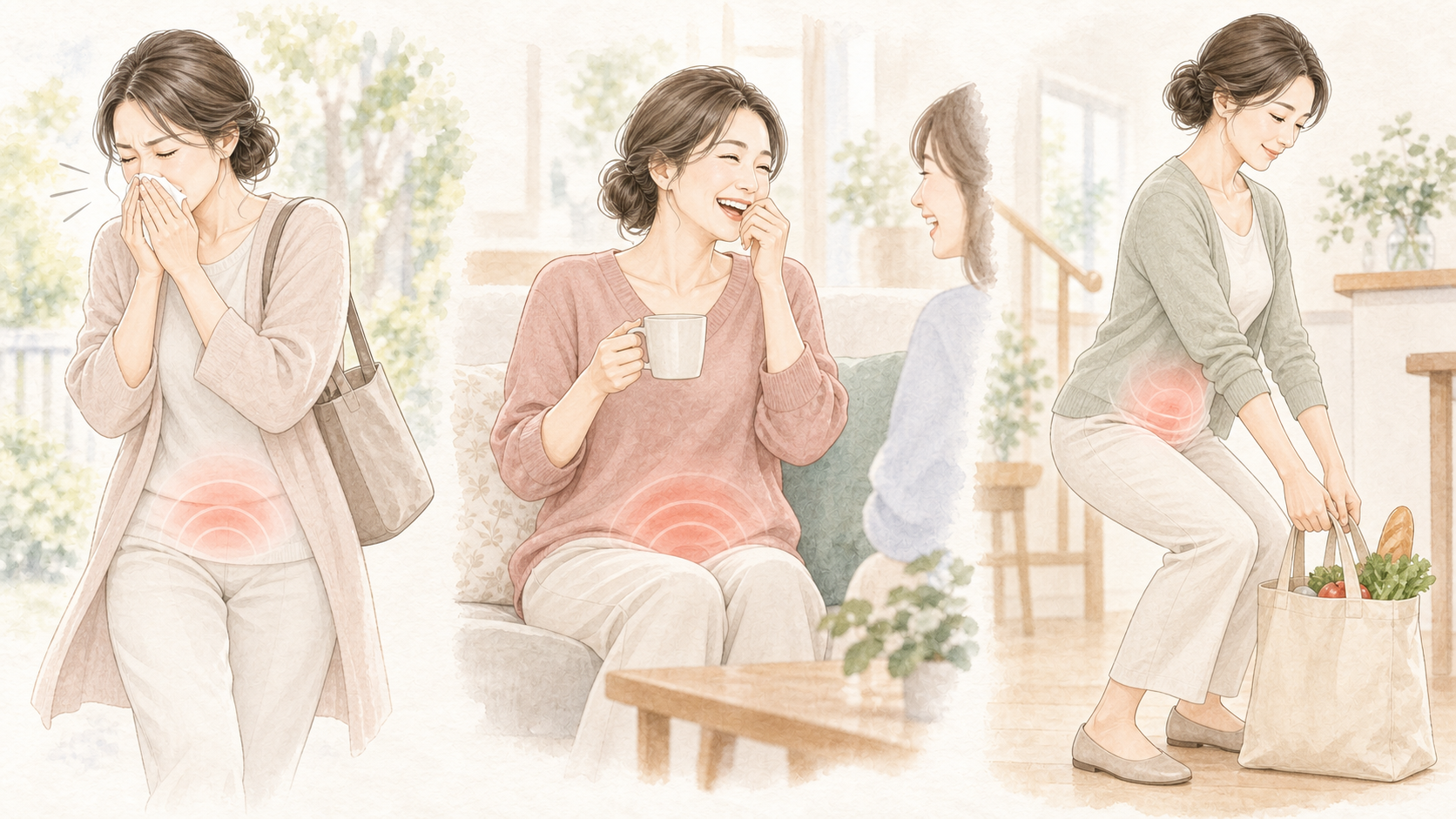
骨盤底筋の働きが落ちると、体には次のような変化が現れることが報告されています。
診察室で、こうしたお話を伺うことがあります。多くの方が、少し声を落として、「たいしたことではないのですが」と前置きをされます。
けれど、これは「たいしたことではない」の中に押し込めておくには、少し大きすぎる話です。旅行に行くとき、トイレの場所を先に確認する。大きく笑うのを、少しためらう。運動を、なんとなくやめる。生活が、少しずつ小さくなっていきます。
性機能や腰まわりの不調との関連は、いずれも骨盤底の状態との「関連」を示す報告であり、骨盤底筋だけが原因と断定するものではありません。また、尿もれの背景には膀胱や神経の病気が隠れていることもあります。急に始まった、量が増えている、痛みや血尿を伴うといった場合は、婦人科・泌尿器科でご相談ください。
4|鍛えれば、変わる。74%と11%の差
ここからが、この記事のいちばん伝えたいところです。
骨盤底筋は、鍛えれば変わることが、きちんと確かめられている筋肉です。
コクラン・レビューという報告形式があります。世界中のランダム化比較試験を集めて統合したもので、医学のエビデンスの中でも信頼性が高いとされるものです。骨盤底筋トレーニングについては、31の試験・1,817人の女性のデータがまとめられています。
結果は、こうでした。
トレーニングをした
改善または治癒
74%
しなかった
改善または治癒
11%
「治った」と評価された方だけで見ても、腹圧性尿失禁では56%対6%。1日あたりの漏れの回数も、トレーニング群で約1回少なくなっていました。
この結果をもとに、骨盤底筋トレーニングは尿失禁に対する保存的治療の第一選択のひとつとして位置づけられています。手術でも、薬でもなく、自分の筋肉を動かすことが、です。
Dumoulin C, Cacciari LP, Hay-Smith EJC. Pelvic floor muscle training versus no treatment, or inactive control treatments, for urinary incontinence in women. Cochrane Database Syst Rev. 2018;10:CD005654./要約版:Cacciari LP, Dumoulin C, Hay-Smith EJ. Braz J Phys Ther. 2019;23(2):93-107.(全文)
妊娠・産後についても、別のコクラン・レビューがあります。妊娠中から骨盤底筋トレーニングを行った方では、産後3〜6か月以降の尿失禁が約29%少なかったと報告されています。
Woodley SJ, Lawrenson P, Boyle R, et al. Pelvic floor muscle training for preventing and treating urinary and faecal incontinence in antenatal and postnatal women. Cochrane Database Syst Rev. 2020;5:CD007471.
変えられないこと(出産・閉経)と、変えられること(筋肉)が、同じ体の中に並んでいます。
5|ただ、半分の方は「違う動かし方」をしている
ここで、知っておいていただきたいデータがあります。

1991年の研究です。女性47名に、標準化された口頭の説明だけを行い、骨盤底筋を締めてもらいました。そのうえで、実際に正しく収縮できているかを確認しています。
正しくできていたのは、23名(約半数)。そして12名(4人に1人)は、いきむような、かえって骨盤底に負担をかけかねない動かし方をしていました。
Bump RC, Hurt WG, Fantl JA, Wyman JF. Assessment of Kegel pelvic muscle exercise performance after brief verbal instruction. Am J Obstet Gynecol. 1991;165(2):322-329.(要旨)
この研究の結論は、はっきりしています。簡単な説明だけでは、骨盤底筋トレーニングを始める準備として十分ではない。
もう一度、1章の話に戻ります。この筋肉は、鏡で見えません。だから「やっているつもり」と「やれている」の間に、差が生まれやすいのです。
効果が出ないのは、続けられなかったからではなく、動かしている場所が違っていたから。そういうことが、実際に起こります。
6|スティムシュア ― 横になったまま、骨盤底筋に「動け」と伝える
ベッドに横になって、20分。本を1章読み終えるくらいの時間です。その間に、装着した部位の筋肉にはおよそ24,000回の「動け」という合図が届きます。それがスティムシュアという治療です。
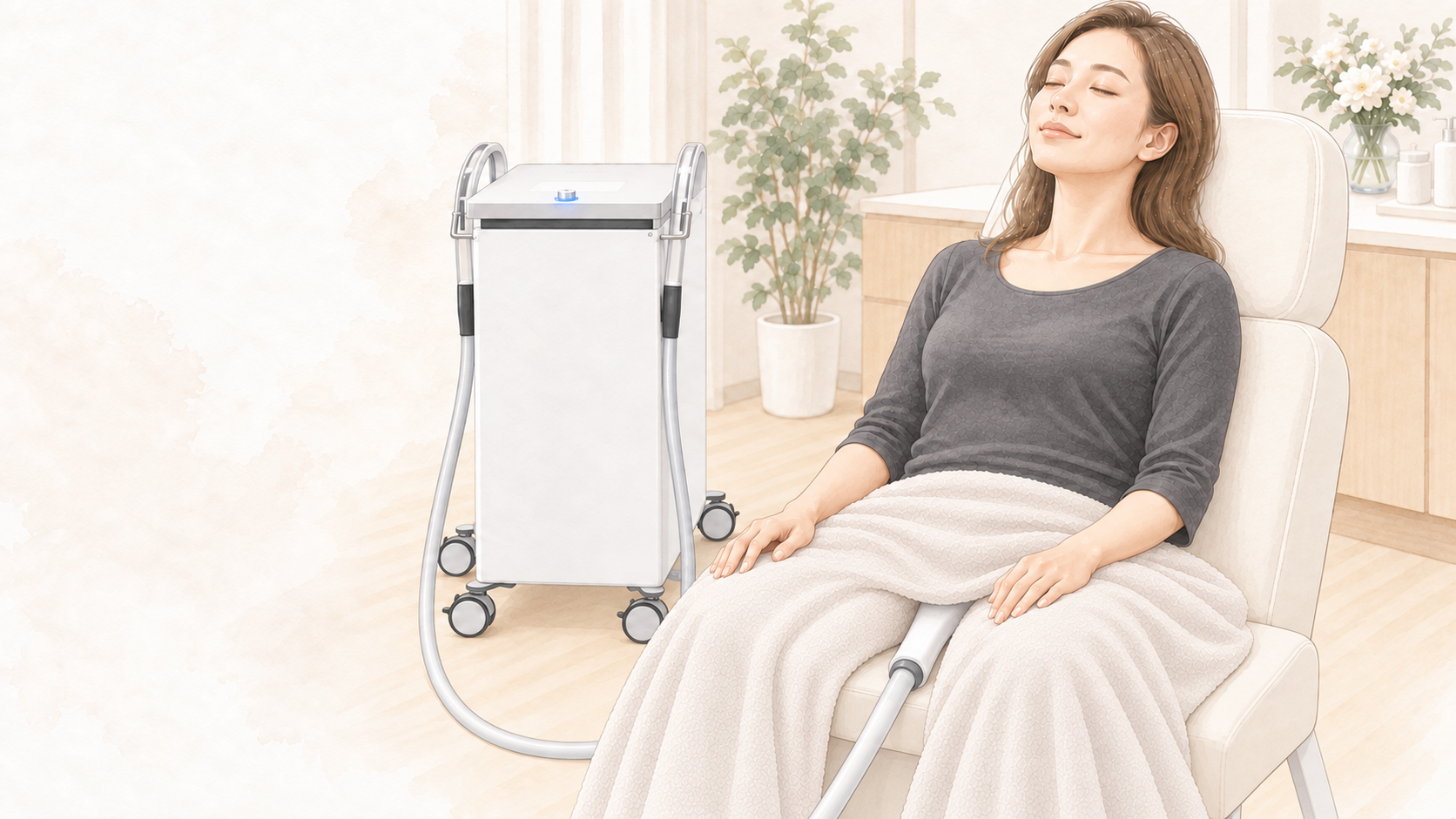
何が起きているのか
スティムシュアは、高エネルギー電磁誘導(High Energy Electromagnetic Inductive Device)と呼ばれる仕組みの医療機器です。電磁的な刺激で、装着した部位の筋肉に収縮と弛緩をくり返させます。自分の意思で力を入れるのではなく、外から合図が届く形です。
座ったまま、あるいは横になったまま。「どこを締めればいいのか分からない」という、いちばん最初の壁を越えなくてよいという点が、この治療の性格をよく表しています。
ご相談いただける部位
当院でご案内しているのは、次の3つの部位です。
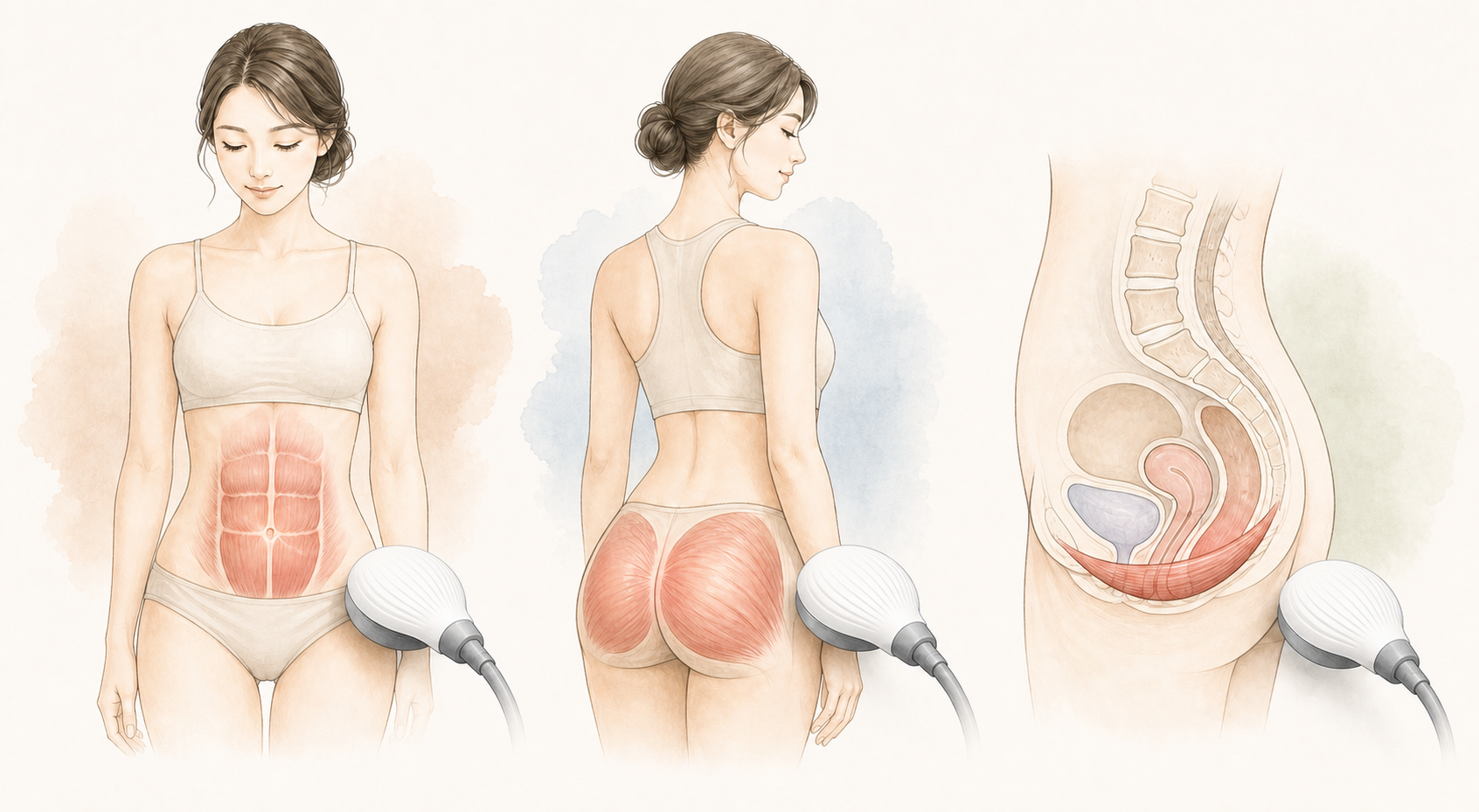
変化は、静かに始まります。臨床試験では、変化を感じられるまで平均8週間程度と示されています。1回で完結する治療ではなく、回数を重ねる前提の治療です。感じ方には個人差があります。
この記事でご紹介した74%・56%という数字は、ご自身で能動的に行う骨盤底筋トレーニングの研究結果です。電磁気刺激による他動的なアプローチは方法が異なり、同じ効果を保証するものではありません。また、尿もれや骨盤底の症状の原因はさまざまです。骨盤底筋への刺激が適しているかは診察で確認し、必要に応じて婦人科・泌尿器科へのご相談もおすすめしています。
費用
1回
1部位
33,000円
4回チケット
1回・1部位
22,000円
(88,000円)
半年以内有効
8回チケット
1回・1部位
16,500円
(132,000円)
半年以内有効
自由診療(保険適用外)です。表示は当院公式サイトの料金表に基づきます。料金は変更される場合がありますので、最新の料金・適応・回数は公式サイトの料金表および診察でご確認ください。
国内未承認医療機器に関する情報開示
受けられない方・注意していただきたいこと
- 体内に磁性体(心臓ペースメーカー、除細動器、人工内耳、可動型義眼、インスリンポンプ、神経刺激装置、人工股関節など)をお持ちの方は施術を受けられません。
- 生理中・妊娠中の方、1週間以内に他機器による部分痩身や類似の施術を受けられた方も施術を受けられません。
- 施術後に、頭痛、筋肉痛、違和感、一時的な筋の収縮(有痛性筋痙攣/筋クランプ)がみられることがあります。多くは時間の経過とともに改善しますが、強い症状や続く症状がある場合は医療機関へご相談ください。
- 体内の医療機器・金属、持病、内服薬、妊娠の可能性については、必ず事前にお申し出ください。
よくある質問
骨盤底筋トレーニングは、どれくらい続ければよいですか?
多くの臨床試験では、週3回程度・12週間前後のプログラムが用いられています。数日で変わるものではなく、数週間から数か月の単位で考えていただく必要があります。感じ方には個人差があり、すべての方に同じ結果を保証するものではありません。
自己流でやっていますが、効いているか分かりません。
その感覚は、めずらしいものではありません。口頭の説明だけで行った場合、正しく収縮できていたのは約半数だったという研究報告があります(Bump RC et al. 1991)。骨盤底筋は目で見えないため、「やっているつもり」と「やれている」の差が生まれやすい筋肉です。一度、確認してから続けることをおすすめします。
スティムシュアを受ければ、この記事の74%という結果が得られますか?
いいえ。74%・56%という数字は、ご自身が能動的に行う骨盤底筋トレーニングの研究結果です。スティムシュアは電磁気刺激で装着部位の筋収縮を補助する治療で、方法が異なります。同じ効果を保証するものではありません。この線引きは、診察でも必ずお伝えしています。
尿もれがあります。まず何科に相談すればよいですか?
尿もれの原因はさまざまで、膀胱や神経の病気が背景にあることもあります。急に始まった、量が増えている、痛みや血尿を伴うといった場合は、まず婦人科・泌尿器科でご相談ください。当院でも、骨盤底筋へのアプローチが適しているかを診察で確認し、必要に応じて専門科へのご相談をおすすめしています。
出産してから何年も経っていますが、今からでも間に合いますか?
骨盤底筋は、年齢を重ねてからでも変化が期待できる筋肉です。コクラン・レビューに含まれる研究の対象には、閉経後の女性も含まれています。ただし効果には個人差があり、症状の程度や原因によって適した方法は異なります。診察でご相談ください。
スティムシュアを受けられない場合はありますか?
あります。体内に磁性体(心臓ペースメーカー、除細動器、人工内耳、可動型義眼、インスリンポンプ、神経刺激装置、人工股関節など)をお持ちの方、生理中・妊娠中の方、1週間以内に他機器による部分痩身や類似施術を受けられた方は施術を受けられません。スティムシュアは国内未承認医療機器であり、自由診療です。ご不明な場合は、ご予約前にお問い合わせいただいて構いません。
RESEARCH NOTE
出典と研究について
本記事の中心となるのは、コクラン共同計画によるシステマティックレビューです。骨盤底筋トレーニングと、無治療または不活性な対照とを比較した31のランダム化比較試験(14か国・女性1,817人)を統合し、腹圧性尿失禁および混合型尿失禁への効果を検討しています。レビューは、骨盤底筋トレーニングが尿失禁の症状を治癒・改善しうることを「確信度の高い」エビデンスとして示し、女性の尿失禁に対する保存的治療の第一選択に含めるべきであると結論づけています。
ただし、含まれる試験の多くは規模が小さく、トレーニングの内容(回数・強度・指導方法)も統一されていません。数字はあくまで研究集団での平均的な傾向であり、個々の方に同じ結果が起こることを約束するものではありません。また、これらは能動的な骨盤底筋トレーニングの研究であり、スティムシュアをはじめとする医療機器の効果を検証したものではありません。
Dumoulin C, Cacciari LP, Hay-Smith EJC. Pelvic floor muscle training versus no treatment, or inactive control treatments, for urinary incontinence in women. Cochrane Database of Systematic Reviews. 2018;10:CD005654. レビュー概要 →
Cacciari LP, Dumoulin C, Hay-Smith EJ. Pelvic floor muscle training versus no treatment… a Cochrane systematic review abridged republication. Brazilian Journal of Physical Therapy. 2019;23(2):93-107.
Woodley SJ, Lawrenson P, Boyle R, et al. Pelvic floor muscle training for preventing and treating urinary and faecal incontinence in antenatal and postnatal women. Cochrane Database of Systematic Reviews. 2020;5:CD007471.
Bump RC, Hurt WG, Fantl JA, Wyman JF. Assessment of Kegel pelvic muscle exercise performance after brief verbal instruction. American Journal of Obstetrics and Gynecology. 1991;165(2):322-329.
Risk factors for pelvic floor dysfunction. NCBI Bookshelf. 2022.
Pelvic floor dysfunction—Does menopause duration matter? Maturitas. 2013;76(2):146-150.
スティムシュアの仕様・適応・費用・副反応に関する記載は、ヒルズグレイスクリニック公式サイトのスティムシュア治療ページに基づきます(2026年9月時点)。
年齢とともに起こる変化を、顔面解剖を基盤に、皮膚・脂肪・筋肉・骨格に起こる加齢変化として読み解き、顔全体のバランスから、その方に必要な治療を設計しています。目指すのは、見た目の変化をきっかけに気持ちが前を向き、日々の行動まで軽やかになるような、自然で調和のとれた変化です。診療では、顔の悩みだけを切り取らず、更年期前後に起こる女性ホルモンの変化や、肌・心・体の揺らぎにも目を向けます。40代以降は、肌をつくり支える細胞の働きが変化し、これまでと同じ治療でも十分な反応が得られないことがあります。だからこそ、まず肌が治療に応えられる状態を整える。この考え方を「CrossTALK® protocol」として体系化し、筆頭著者として2025年にJournal of Cosmetic Dermatologyに発表しました。2016年より、ボトックスビスタやジュビダームを展開するアラガン・エステティックス ジャパンファカルティーの一員として、また注入指導医として、医師への教育・指導にも携わっています。「美容医療は患者を幸せにするのか」という問いについては、大学との共同研究を通じて探究を続けています。必要な治療を、必要な順番で、必要な分だけ。年齢とともに変化する顔と人生に寄り添い、長く信頼して相談できる「美容のかかりつけ医」でありたいと考えています。詳しいプロフィール →
TREATMENT INFORMATION
治療について
- 施術名
- スティムシュア(StimSure)
- 診療区分
- 自由診療(保険適用外)
- 使用量・部位
- 腹部・臀部・骨盤底筋など。適応・装着方法は診察で確認します。
- 公式料金の目安
-
1回
1部位
33,000円
4回チケット
1回・1部位
22,000円
(88,000円)
半年以内有効
8回チケット
1回・1部位
16,500円
(132,000円)
半年以内有効
表示は公式料金の目安です。自由診療(保険適用外)です。最新の料金・適応・回数は公式案内および診察でご確認ください。
- 主な副作用・リスク
- 施術後の頭痛、筋肉痛、違和感、一時的な筋肉のけいれん(有痛性筋けいれん)などが起こることがあります。体内に磁性体(心臓ペースメーカー、除細動器、人工内耳、インスリンポンプ、人工股関節など)をお持ちの方、生理中・妊娠中の方は受けられません。
- 未承認医療機器に関する事項
- スティムシュアは、国内で医療機器として認証を受けています(医療機器認証番号 303AIBZX00029000、一般的名称:磁気刺激装置、販売名:スティムシュア)。認証された使用目的は「磁気を用いて末梢神経を刺激し、生体の誘発反応の検査に用いる」ことで、筋肉の強化・引き締めを目的とした使用は、承認・認証された使用目的に含まれない適応外使用です。国内販売元であるサイノシュアー・ルートロニック株式会社より入手しています。筋肉の強化・引き締めを使用目的とする、同一の性能を有する国内承認医療機器はありません。欧州でCEマーク(適応:筋萎縮)を取得し、2019年に欧州・中東で発売されています(メーカー発表)。米国では販売されていないとメーカーが公表しており(2019年)、米国FDAの510(k)クリアランスは確認できていません。主なリスクとして、筋肉痛、頭痛、筋けいれん等が報告されています。
CLINIC INFORMATION
ヒルズグレイスクリニック
アクセスの詳細を見る →
肌を整える時間を、診察の外にも。


Just as you reach the bottom of the station stairs, a single sneeze.
“Oh,” you think. Only a little, but definitely. Then you carry on walking as if nothing had happened.
Have you ever told anyone about this? Most people have not, even once.
Key points
A small leak when you sneeze or cough is not because you lack self-control, nor is it simply age. It happens because the pelvic floor muscles, which support the organs at the base of the pelvis, change through two events: childbirth and menopause. And here is the important part. The pelvic floor muscles have been shown to change with training. However, one report found that when women started with verbal explanation alone, only about half were moving the muscles correctly. Learn first, then start. It may look like a detour, but it is the shortest route.
1 | A “hammock” at the base of the pelvis, supporting the organs
The pelvic floor muscles are a layer of muscle stretched across the base of the pelvis. They support the bladder, uterus and bowel from below, like a hammock.
What is remarkable about these muscles is that they work all day long, without rest. When you stand, when you laugh, when you lift a heavy bag. Every time pressure builds in the abdomen, they catch the internal organs from below so that they do not drop. With every breath, they also move slowly up and down in step with the diaphragm.
Yet these muscles cannot be seen in a mirror. With the muscles of the arm, you can see them bulge when you tense them. With the abdomen, you can tell by touching it. The pelvic floor muscles alone offer no way of checking whether they are moving, other than your own sensation.
Because you cannot see them, you do not notice. Because you do not notice, you cannot act while they are changing. I wrote this article to fill in that “invisibility”.
2 | Childbirth and menopause: two reasons the pelvic floor muscles change
Slackening of the pelvic floor muscles is not caused by weak willpower, nor only by a lack of exercise. There are clear factors that research has confirmed again and again.
First: childbirth
Vaginal delivery has been reported as one of the strongest risk factors for pelvic floor dysfunction in women under 60. Having many children and perineal tears during delivery are also thought to be associated with long-term pelvic floor symptoms.
As the baby passes through, the pelvic floor muscles and the nerves around them are stretched to the very limit. Most recover over time, but they do not necessarily return to exactly how they were before childbirth. That is not a sign that the body is broken; it is the mark of a great piece of work.
Risk factors for pelvic floor dysfunction. In: StatPearls / NCBI Bookshelf. (Full text)
Second: menopause
The other is menopause.
The tissues that support the pelvis have oestrogen receptors that regulate the synthesis and breakdown of collagen. When oestrogen falls at menopause, the muscles become thinner and the supporting collagen also decreases. Picture the fabric of the hammock itself gradually wearing thin.
One report estimates that up to about four in ten postmenopausal women have some kind of pelvic floor problem.
Pelvic floor dysfunction—Does menopause duration matter? Maturitas. 2013. / Local Oestrogen for Pelvic Floor Disorders: A Systematic Review. PLOS ONE. 2015.
Other factors cited as adding to the strain on the pelvic floor include obesity, chronic constipation and a long-lasting cough, conditions that repeatedly put pressure on the abdomen. Easing constipation is also a form of pelvic floor care.
3 | What has been dismissed as “just age”
When the pelvic floor muscles work less well, the following changes have been reported to appear in the body.
In the consultation room, I sometimes hear about these things. Many women lower their voice a little and begin with, “It’s nothing serious, but…”
But this is a little too big to keep tucked away under “nothing serious”. When going on a trip, you check where the toilets are first. You hesitate a little before laughing out loud. You somehow stop exercising. Life gradually becomes a little smaller.
The links with sexual function and lower-back problems come from reports showing an “association” with the state of the pelvic floor; they do not establish that the pelvic floor muscles alone are the cause. Urinary leakage may also have an underlying bladder or nerve disorder. If it started suddenly, is increasing in amount, or comes with pain or blood in the urine, please consult a gynaecologist or urologist.
4 | Training makes a difference: 74% versus 11%
This is what I most want to convey in this article.
The pelvic floor muscles have been properly shown to change with training.
There is a type of report called a Cochrane Review. It gathers and combines randomised controlled trials from around the world and is regarded as one of the most reliable forms of evidence in medicine. For pelvic floor muscle training, it brings together data from 31 trials and 1,817 women.
The results were as follows.
Trained
Improved or cured
74%
Did not train
Improved or cured
11%
Looking only at those assessed as “cured”, the figure for stress urinary incontinence was 56% versus 6%. The number of leaks per day was also about one fewer in the training group.
On the basis of these results, pelvic floor muscle training is positioned as one of the first-line conservative treatments for urinary incontinence. Not surgery, not medication, but moving your own muscles.
Dumoulin C, Cacciari LP, Hay-Smith EJC. Pelvic floor muscle training versus no treatment, or inactive control treatments, for urinary incontinence in women. Cochrane Database Syst Rev. 2018;10:CD005654. / Summary: Cacciari LP, Dumoulin C, Hay-Smith EJ. Braz J Phys Ther. 2019;23(2):93-107. (Full text)
There is also a separate Cochrane Review on pregnancy and the postnatal period. It reports that women who did pelvic floor muscle training from pregnancy onwards had about 29% less urinary incontinence from 3–6 months after childbirth.
Woodley SJ, Lawrenson P, Boyle R, et al. Pelvic floor muscle training for preventing and treating urinary and faecal incontinence in antenatal and postnatal women. Cochrane Database Syst Rev. 2020;5:CD007471.
What cannot be changed (childbirth, menopause) and what can be changed (the muscles) sit side by side in the same body.
5 | But half of women are moving them “differently”
Here is some data I would like you to know.
This is a 1991 study. 47 women were given only standardised verbal instructions and asked to contract their pelvic floor muscles. The researchers then checked whether they were actually contracting them correctly.
Those who did it correctly numbered 23 (about half). And 12 (one in four) were moving in a way that resembled bearing down, which could actually put strain on the pelvic floor.
Bump RC, Hurt WG, Fantl JA, Wyman JF. Assessment of Kegel pelvic muscle exercise performance after brief verbal instruction. Am J Obstet Gynecol. 1991;165(2):322-329. (Abstract)
The conclusion of this study is clear: brief explanation alone is not sufficient preparation for starting pelvic floor muscle training.
Let me return once more to Section 1. These muscles cannot be seen in a mirror. That is why a gap so easily opens up between “thinking you are doing it” and “actually doing it”.
When there is no effect, it is not because you could not keep going, but because you were moving the wrong place. That really does happen.
6 | StimSure: telling the pelvic floor muscles to “move” while you lie down
Lie on a bed for 20 minutes, about the time it takes to finish one chapter of a book. During that time, the muscles in the area where the device is applied receive approximately 24,000 signals to “move”. That is the treatment called StimSure.
What is happening
StimSure is a medical device based on a mechanism called high-energy electromagnetic induction (High Energy Electromagnetic Inductive Device). Electromagnetic stimulation makes the muscles in the area where it is applied repeatedly contract and relax. Rather than you tensing the muscles by your own will, the signal arrives from outside.
Seated, or lying down. The fact that you do not have to get over the very first hurdle of “I don’t know which part to squeeze” captures the character of this treatment well.
Areas you can consult us about
At our clinic, we offer the following three areas.
Change begins quietly. Clinical trials indicate that it takes about 8 weeks on average before change can be felt. This is not a treatment completed in a single session; it assumes repeated sessions. How changes are felt varies between individuals.
The figures of 74% and 56% presented in this article are the results of studies of pelvic floor muscle training that women actively perform themselves. A passive approach using electromagnetic stimulation is a different method and does not guarantee the same effect. The causes of urinary leakage and pelvic floor symptoms also vary. Whether stimulation of the pelvic floor muscles is suitable is confirmed at the examination, and where necessary we also recommend consulting a gynaecologist or urologist.
Fees
1 session
1 area
33,000 yen
4-session ticket
Per session, 1 area
22,000 yen
(¥88,000)
Valid for six months
8-session ticket
Per session, 1 area
16,500 yen
(¥132,000)
Valid for six months
This is private, self-funded care (not covered by health insurance). The prices shown are based on the fee schedule on our clinic’s official website. Fees may change, so please check the latest fees, suitability and number of sessions in the fee schedule on the official website and at your consultation.
Disclosure regarding a medical device not approved in Japan
Who cannot receive the treatment and points to note
- People with magnetic materials in the body (cardiac pacemaker, defibrillator, cochlear implant, movable artificial eye, insulin pump, neurostimulator, artificial hip joint, etc.) cannot receive the treatment.
- People who are menstruating or pregnant, and people who have received localised body contouring or a similar treatment with another device within the past week, also cannot receive the treatment.
- After treatment, headache, muscle pain, discomfort or temporary muscle contraction (painful muscle spasm / muscle cramp) may occur. Most improve with time, but if symptoms are severe or persist, please consult a medical institution.
- Please be sure to tell us in advance about any medical devices or metal in your body, chronic conditions, medications you take, or the possibility of pregnancy.
Frequently asked questions
How long should I continue pelvic floor muscle training?
Many clinical trials use programmes of around three times a week for about 12 weeks. It does not change in a few days; you need to think in terms of weeks to months. How changes are felt varies between individuals, and the same result is not guaranteed for everyone.
I’m doing it my own way, but I can’t tell whether it’s working.
That feeling is not unusual. A study reported that when women relied on verbal explanation alone, only about half were contracting correctly (Bump RC et al. 1991). Because the pelvic floor muscles cannot be seen, a gap easily opens up between “thinking you are doing it” and “actually doing it”. We recommend having it checked once before continuing.
If I have StimSure, will I get the 74% result described in this article?
No. The figures of 74% and 56% are the results of studies of pelvic floor muscle training that women actively perform themselves. StimSure is a treatment that uses electromagnetic stimulation to assist muscle contraction in the area where it is applied, and it is a different method. It does not guarantee the same effect. We always explain this distinction at the consultation too.
I have urinary leakage. Which department should I consult first?
Urinary leakage has many causes, and an underlying bladder or nerve disorder may be involved. If it started suddenly, is increasing in amount, or comes with pain or blood in the urine, please first consult a gynaecologist or urologist. At our clinic, too, we confirm at the examination whether a pelvic floor approach is suitable and, where necessary, recommend consulting a specialist department.
It has been many years since I gave birth. Is it too late to start now?
The pelvic floor muscles are muscles in which change can be expected even with age. The studies included in the Cochrane Review also included postmenopausal women. However, results vary between individuals, and the suitable approach differs depending on the severity and cause of the symptoms. Please consult us at an examination.
Are there cases in which I cannot have StimSure?
Yes. People with magnetic materials in the body (cardiac pacemaker, defibrillator, cochlear implant, movable artificial eye, insulin pump, neurostimulator, artificial hip joint, etc.), people who are menstruating or pregnant, and people who have received localised body contouring or a similar treatment with another device within the past week cannot receive the treatment. StimSure is a medical device not approved in Japan, and the treatment is private, self-funded care. If you are unsure, please feel free to contact us before booking.
RESEARCH NOTE
About the sources and research
The core of this article is a systematic review by the Cochrane Collaboration. It combined 31 randomised controlled trials (14 countries, 1,817 women) comparing pelvic floor muscle training with no treatment or inactive control, and examined its effect on stress and mixed urinary incontinence. The review presented “high-certainty” evidence that pelvic floor muscle training can cure or improve the symptoms of urinary incontinence, and concluded that it should be included as a first-line conservative treatment for urinary incontinence in women.
However, many of the included trials were small, and the content of the training (frequency, intensity, method of instruction) was not standardised. The figures are only average tendencies in the study populations and do not promise that the same result will occur for any individual. In addition, these are studies of active pelvic floor muscle training; they did not examine the effect of medical devices, including StimSure.
Dumoulin C, Cacciari LP, Hay-Smith EJC. Pelvic floor muscle training versus no treatment, or inactive control treatments, for urinary incontinence in women. Cochrane Database of Systematic Reviews. 2018;10:CD005654. Review summary →
Cacciari LP, Dumoulin C, Hay-Smith EJ. Pelvic floor muscle training versus no treatment… a Cochrane systematic review abridged republication. Brazilian Journal of Physical Therapy. 2019;23(2):93-107.
Woodley SJ, Lawrenson P, Boyle R, et al. Pelvic floor muscle training for preventing and treating urinary and faecal incontinence in antenatal and postnatal women. Cochrane Database of Systematic Reviews. 2020;5:CD007471.
Bump RC, Hurt WG, Fantl JA, Wyman JF. Assessment of Kegel pelvic muscle exercise performance after brief verbal instruction. American Journal of Obstetrics and Gynecology. 1991;165(2):322-329.
Risk factors for pelvic floor dysfunction. NCBI Bookshelf. 2022.
Pelvic floor dysfunction—Does menopause duration matter? Maturitas. 2013;76(2):146-150.
The descriptions of StimSure’s specifications, indications, fees and adverse reactions are based on the StimSure treatment page on the Hills Grace Clinic official website (as of September 2026).
Grounded in facial anatomy, I read the changes that occur with age as ageing changes in the skin, fat, muscle and bone, and design the treatment each person needs based on the balance of the face as a whole. What I aim for is natural, harmonious change, in which a change in appearance becomes the trigger for a more positive outlook and a lighter step in everyday life. In my practice, I do not look at facial concerns in isolation, but also pay attention to the changes in female hormones around the menopausal years and the fluctuations of skin, mind and body. From the 40s onwards, the activity of the cells that build and support the skin changes, and the same treatments as before may not produce a sufficient response. That is why I first prepare the skin so that it can respond to treatment. I systematised this approach as the “CrossTALK® protocol” and published it as first author in the Journal of Cosmetic Dermatology in 2025. Since 2016, I have been involved in educating and training doctors as a member of the Japan faculty of Allergan Aesthetics, which offers Botox Vista and Juvéderm, and as an injection training physician. I continue to explore the question “Does aesthetic medicine make patients happy?” through joint research with a university. The treatment that is needed, in the order it is needed, in the amount it is needed. I want to be a “family doctor for aesthetics” who stays alongside faces and lives as they change with age, and whom patients can trust and consult for many years. Full profile →
TREATMENT INFORMATION
About the treatment
- Treatment name
- StimSure
- Category of care
- Private, self-funded care (not covered by health insurance)
- Amount and areas
- Abdomen, buttocks, pelvic floor muscles, etc. Suitability and how the device is applied are confirmed at the examination.
- Standard fees
-
1 session
1 area
33,000 yen
4-session ticket
Per session, 1 area
22,000 yen
(¥88,000)
Valid for six months
8-session ticket
Per session, 1 area
16,500 yen
(¥132,000)
Valid for six months
The prices shown are a guide to the standard fees. This is private, self-funded care (not covered by health insurance). Please check the latest fees, suitability and number of sessions in the official information and at your consultation.
- Main side effects and risks
- Headache, muscle pain, discomfort or temporary muscle spasm (painful muscle cramp) may occur after treatment. People with magnetic materials in the body (cardiac pacemaker, defibrillator, cochlear implant, insulin pump, artificial hip joint, etc.) and people who are menstruating or pregnant cannot receive the treatment.
- Unapproved medical devices
- StimSure has received certification as a medical device in Japan (medical device certification number 303AIBZX00029000; generic name: magnetic stimulator; brand name: StimSure). Its certified intended use is “to stimulate peripheral nerves using magnetism, for use in testing evoked responses of the body”; use for the purpose of strengthening and toning muscles is off-label use not included in the approved or certified intended use. It is obtained from Cynosure Lutronic K.K., the domestic distributor. There is no medical device approved in Japan with the same performance whose intended use is strengthening and toning muscles. It has obtained the CE mark in Europe (indication: muscle atrophy) and was launched in Europe and the Middle East in 2019 (manufacturer announcement). The manufacturer has stated that it is not sold in the United States (2019), and US FDA 510(k) clearance could not be confirmed. The main reported risks include muscle pain, headache and muscle cramps.
CLINIC INFORMATION
Hills Grace Clinic
Access details →
Caring for your skin beyond the consultation room
HOME CARE
Online shop
Doctor-selected skincare and supplements, delivered to your home. For some products, a free online consultation is available before purchase.
CONSULTATION
Consult us at the clinic
Every person's skin is different. We look into what lies behind pigmentation and melasma, and suggest the care and the order of treatment your skin needs now.