

GRACE JOURNAL
思春期からVIOまで。医師とスタッフが支える医療脱毛

この記事の要点
ヒルズグレイスクリニックでは、開院当初から医療脱毛を行っています。診察だけでなく、ダイオードレーザー「Vectus(ベクタス)」による照射も医師が担当。思春期の脱毛やVIO(デリケートライン)など、繊細なお悩みに向き合いながら、スタッフは麻酔・冷却・振動を用いた介助で治療を支えます。
はじめに|開院当初から続けてきた医療脱毛
エイジングケアのイメージが強いヒルズグレイスクリニックですが、実は開院当初から続けてきた治療があります。
医療レーザー脱毛です。
脱毛は、ただレーザーを当てればよい治療ではありません。肌の色調、毛の太さや密度、照射する部位によって、適切な設定や通院の間隔は変わります。だからこそ当院では、医師が診察し、自らレーザーを照射しています。
1. 医師が診て、医師が照射する
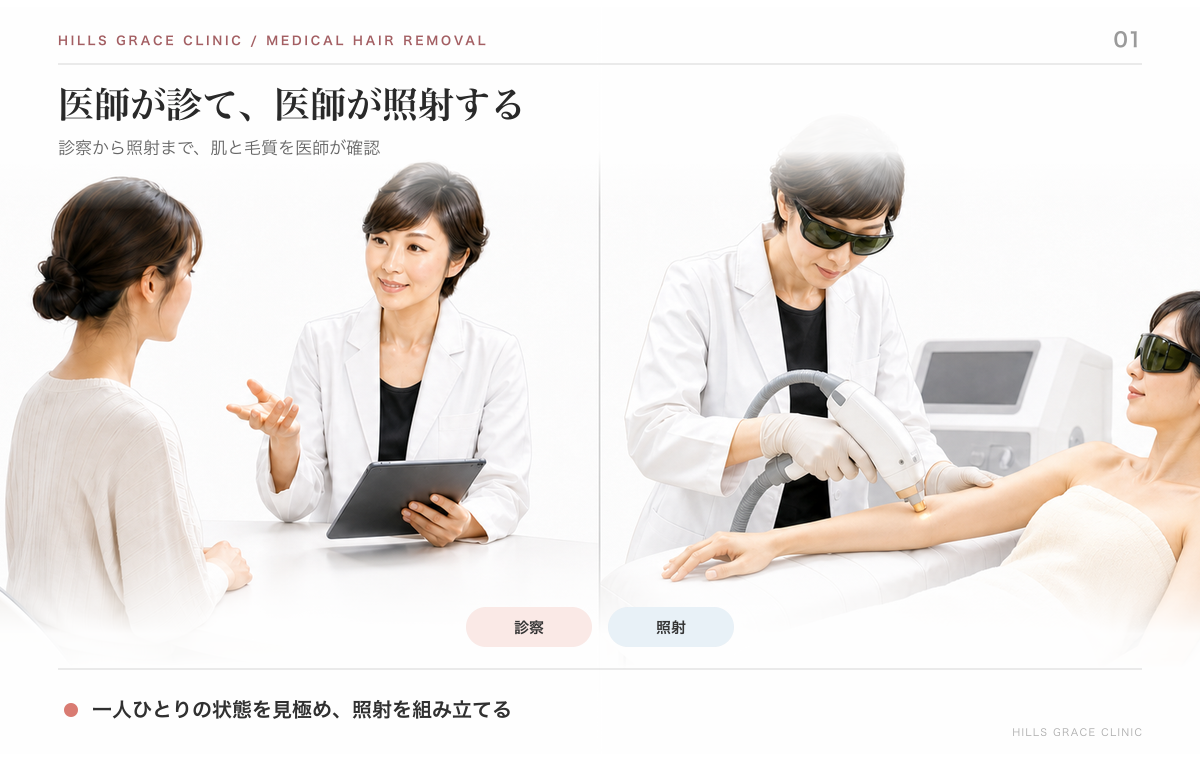
ヒルズグレイスクリニックの医療脱毛では、医師が肌の状態と毛質を確認し、照射の可否や出力を判断します。照射を行うのも医師です。
敏感肌の方や未成年の方、デリケートな部位の脱毛など、不安を言葉にしづらいときにも、診察から照射まで一貫して相談できる体制を大切にしています。
2. ダイオードレーザー「ベクタス」で治療を設計する
使用するのは、ダイオードレーザーVectus(ベクタス)です。皮膚の色調、毛の太さ、毛の密度などを確認し、照射設定を決めていきます。
毛には成長期・退行期・休止期という「毛周期」があるため、1回ですべての毛を処理することはできません。当院では毛質や部位を診ながら、必要以上に回数を重ねない治療計画を目指します。通常は5〜6回程度が一つの目安ですが、必要な回数や期間には個人差があります。
3. 思春期の脱毛|自己処理による肌負担を減らすために
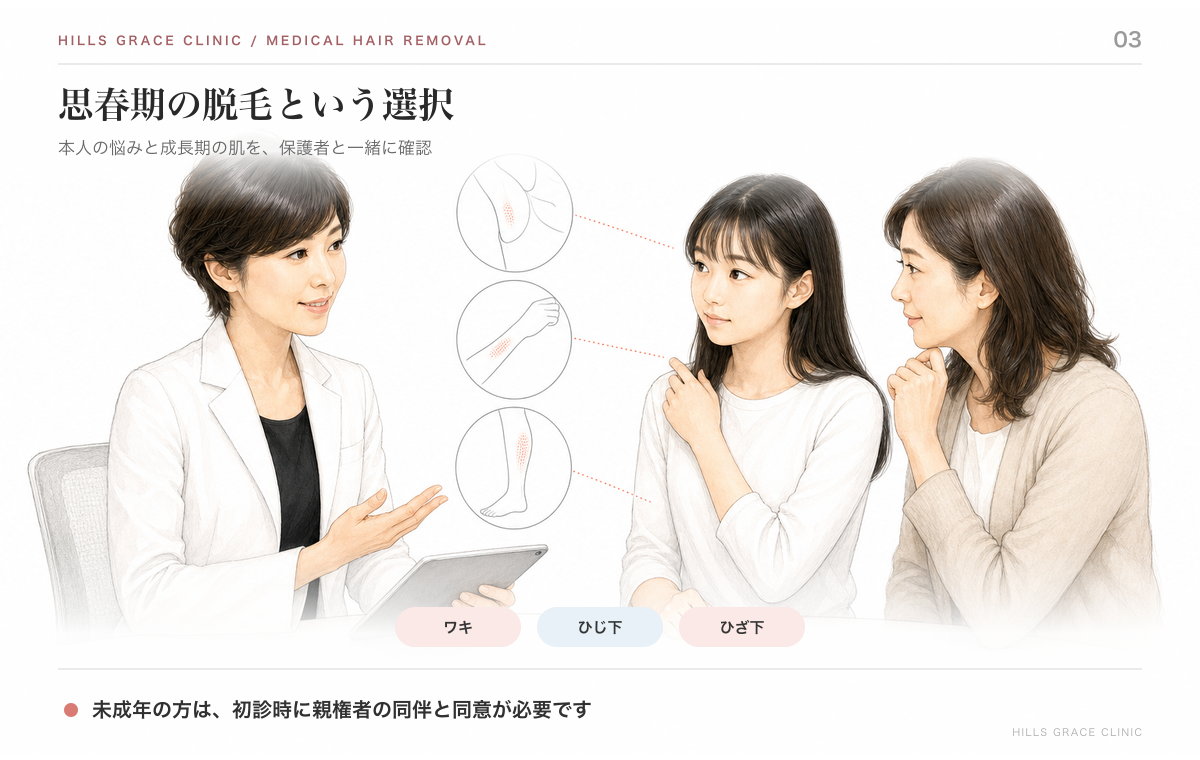
思春期になると、ワキや腕、脚の毛が気になり、繰り返し自己処理をする方も増えてきます。カミソリなどによる自己処理は、赤みや肌荒れにつながることがあります。
当院では、未成年の方も医療脱毛をご相談いただけます。初診時には親権者の方の同伴と、施術同意書への署名が必要です。成長期は毛の状態が変化しやすいため、肌状態だけでなく、通院の時期や目的についても保護者の方と一緒に確認します。
4. VIO脱毛|話しにくいことを、話せる医療へ
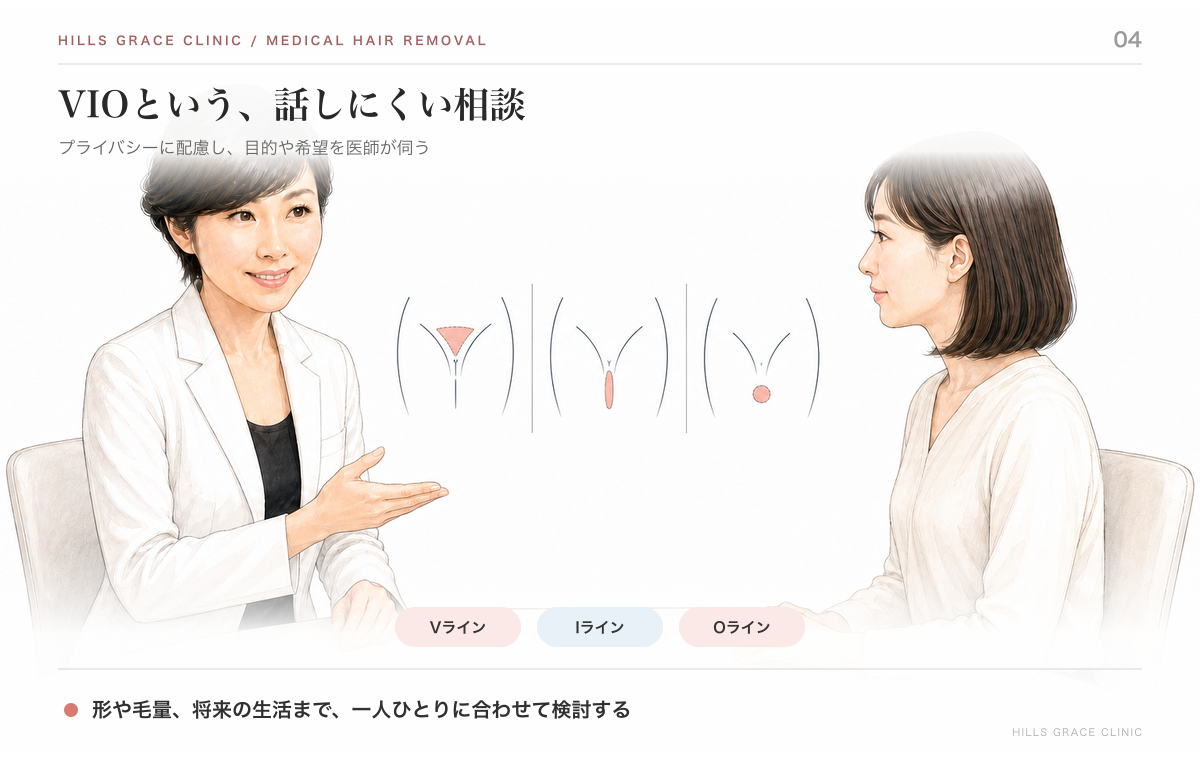
VIOは、自己処理の難しさや肌トラブルについて人に相談しづらい部位です。日々のお手入れを楽にしたいという方だけでなく、将来の生活や介護を考え、脱毛を検討される方もいらっしゃいます。
デリケートな部位だからこそ、医師が肌の状態を確認しながら照射します。形や毛量についての希望も伺い、一人ひとりに合わせて治療方針を検討します。
5. 麻酔・冷却・振動|負担に配慮する“三種の神器”
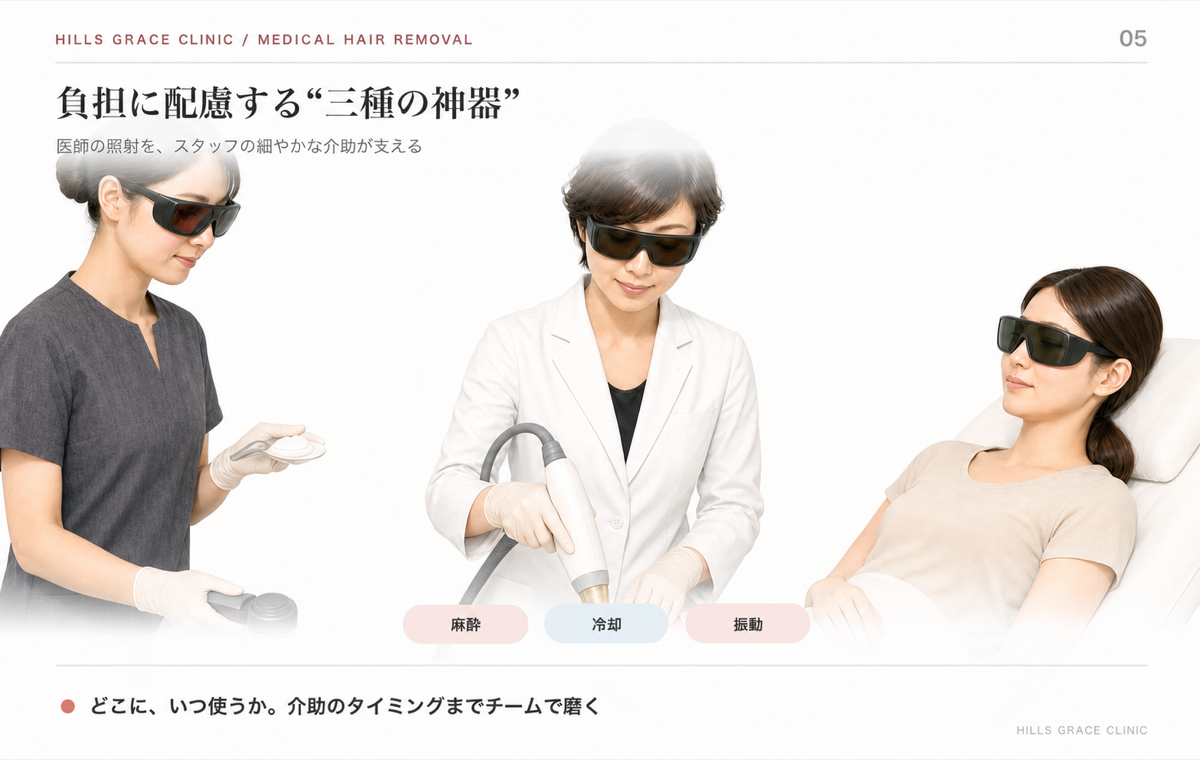
照射を担当するのは医師ですが、その治療を隣で支えるのがスタッフです。
部位や状態に応じて麻酔、冷却、振動を使い分けます。どこを冷やすか。いつ振動を加えるか。次の照射へどう備えるか。わずかなタイミングの違いが、患者様の感じ方に影響します。
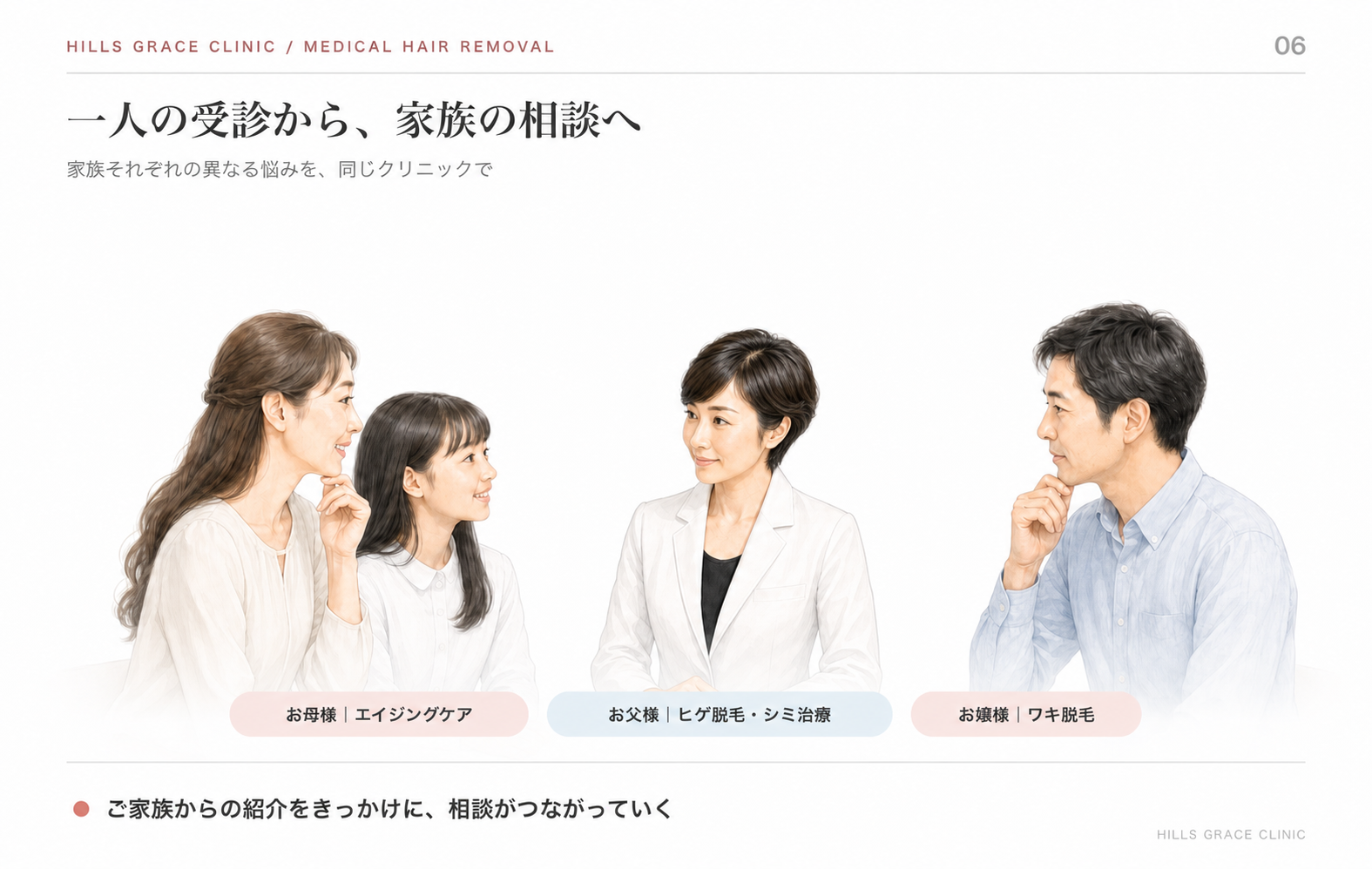
6. お母様から、お父様へ。ご家族からの紹介も
ヒルズグレイスクリニックでは、ご家族からの紹介をきっかけに受診される方もいらっしゃいます。
お母様はエイジングケア、お父様はヒゲ脱毛やシミ治療、お嬢様はワキ脱毛。ご家族それぞれの異なるお悩みを、同じクリニックでご相談いただくケースもあります。
脱毛も、チーム医療
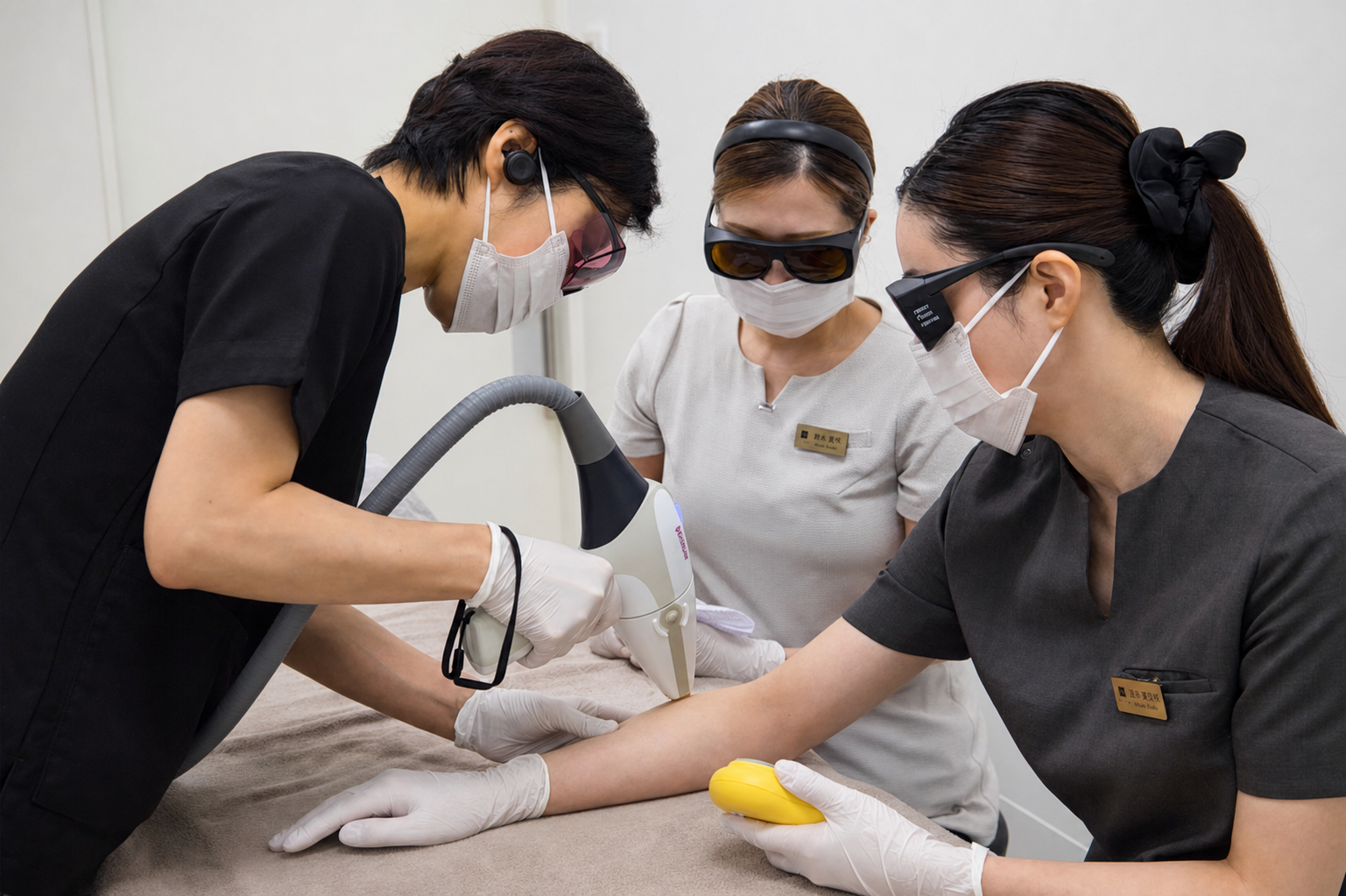
今回院内で行ったのは、介助レッスン。できるだけ負担に配慮しながら治療を受けていただくために、細部の動きまでチームで確認しました。
医師が肌と毛質を見極め、レーザーを照射する。その一発一発を、スタッフの細やかな介助が支える。
ただ毛を減らすことだけではなく、できるだけ負担に配慮しながら、納得できる治療につなげること。今日も私たちは、細部へのこだわりをチームで磨いています。
医療脱毛の治療情報
- 使用機器:Vectus(ベクタス)/ダイオードレーザー
- 診療区分:自由診療(保険適用外)
- 回数・期間:通常5〜6回程度、数か月〜1年程度が目安。部位・毛質・肌状態により異なります。
- 施術間隔:身体は1.5〜2か月に1回、顔は1か月に1回程度が目安です。
- 主な費用例:両ワキ1回13,200円、Vライン1回33,000円、Iライン1回16,500円、Oライン1回16,500円、デリケートプラン(V・I・O)1回46,200円(いずれも税込)。通常5〜6回を受ける場合の施術料金例は、両ワキ66,000〜79,200円、デリケートプラン231,000〜277,200円(税込)です。
- 診察・麻酔費:初診料11,000円、再診料5,500円。希望時は麻酔クリーム代5,500円が別途かかります。
- 主な副作用・リスク:紅斑、浮腫、火傷、色素沈着、毛嚢炎などが生じることがあります。
- 未承認医療機器について:Vectusは日本国内で薬機法上の承認を得ていない医療機器です。国内代理店を通じて入手し、米国FDAではダイオードレーザーによる脱毛治療の適応で承認されています。同一性能を有する国内承認機器はありません。
よくある質問
未成年でも医療脱毛を受けられますか?
ご相談いただけます。初診時には親権者の方の同伴と、施術同意書への署名が必要です。
VIOだけでも相談できますか?
はい。Vライン・Iライン・Oラインを個別に相談できるほか、V・I・Oを組み合わせたデリケートプランもあります。
何回くらい通いますか?
通常5〜6回程度が一つの目安ですが、部位や毛質、肌状態などによって異なります。医師が毛の状態を確認し、照射時期をご案内します。
おわりに
医療脱毛は、毛だけを見る治療ではありません。肌の状態、毛質、通院の時期、そして治療に対する不安まで、一人ひとり異なります。
医師が診て照射し、スタッフが細やかな介助で支える。ヒルズグレイスクリニックでは、この連携を大切にしながら、思春期の脱毛からVIOのご相談まで丁寧に向き合っています。
※本記事は医療脱毛に関する一般的な情報提供を目的としています。治療効果、必要回数、痛みの感じ方には個人差があります。医療脱毛は自由診療(保険適用外)です。適応や照射設定は診察のうえで判断します。
思春期の脱毛やVIOなど、話しにくいお悩みも診察時にご相談ください。肌と毛の状態を確認し、治療方法と必要な回数の目安をご説明します。
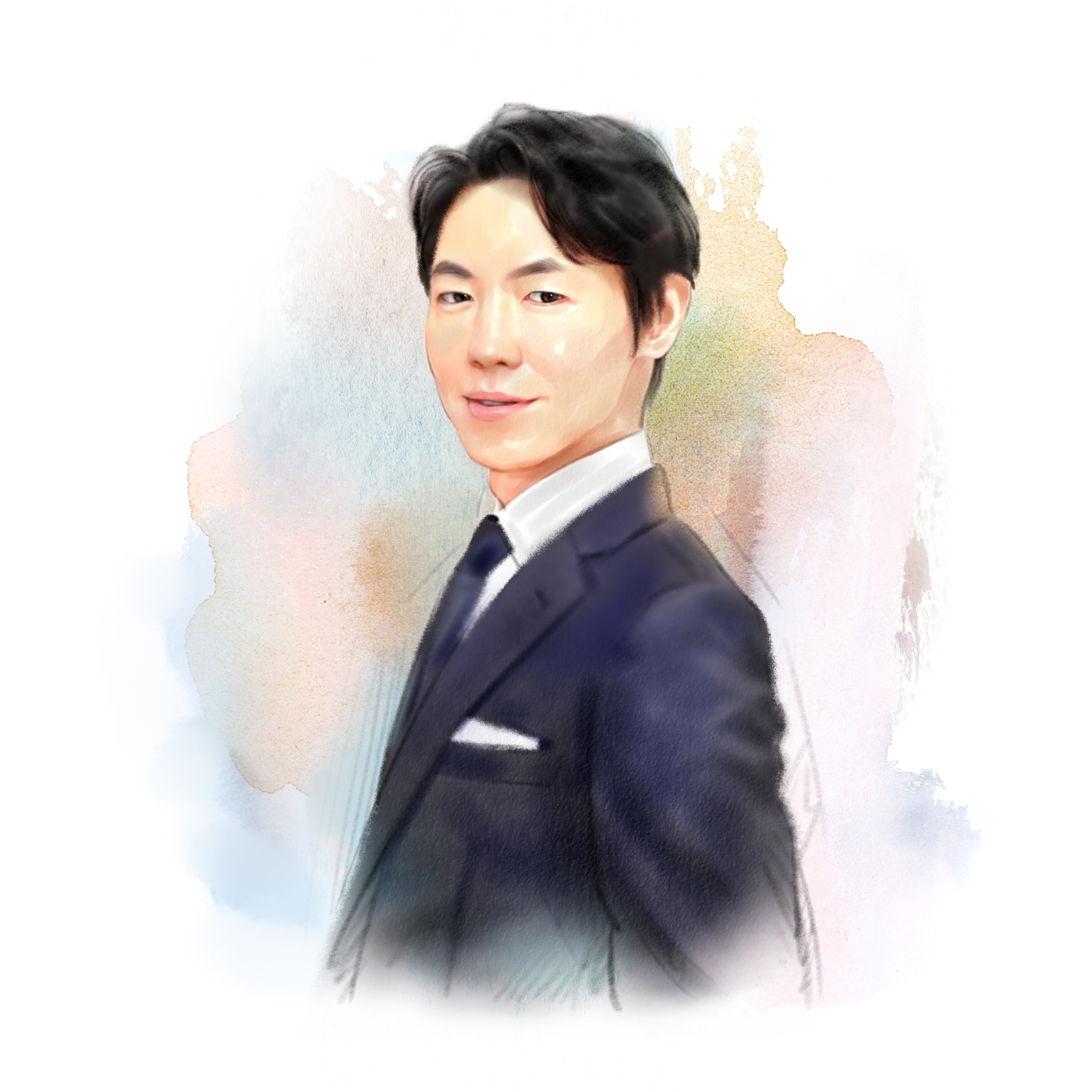
年齢とともに起こる変化を、顔面解剖を基盤に、皮膚・脂肪・筋肉・骨格に起こる加齢変化として読み解き、顔全体のバランスから、その方に必要な治療を設計しています。目指すのは、見た目の変化をきっかけに気持ちが前を向き、日々の行動まで軽やかになるような、自然で調和のとれた変化です。診療では、顔の悩みだけを切り取らず、更年期前後に起こる女性ホルモンの変化や、肌・心・体の揺らぎにも目を向けます。40代以降は、肌をつくり支える細胞の働きが変化し、これまでと同じ治療でも十分な反応が得られないことがあります。だからこそ、まず肌が治療に応えられる状態を整える。この考え方を「CrossTALK® protocol」として体系化し、筆頭著者として2025年にJournal of Cosmetic Dermatologyに発表しました。2016年より、ボトックスビスタやジュビダームを展開するアラガン・エステティックス ジャパンファカルティーの一員として、また注入指導医として、医師への教育・指導にも携わっています。「美容医療は患者を幸せにするのか」という問いについては、大学との共同研究を通じて探究を続けています。必要な治療を、必要な順番で、必要な分だけ。年齢とともに変化する顔と人生に寄り添い、長く信頼して相談できる「美容のかかりつけ医」でありたいと考えています。詳しいプロフィール →
CLINIC INFORMATION
ヒルズグレイスクリニック
アクセスの詳細を見る →
肌を整える時間を、診察の外にも。

GRACE JOURNAL
From adolescence to VIO: medical hair removal supported by doctors and staff
Key points
Hills Grace Clinic has offered medical hair removal since it first opened. Doctors handle not only the consultation but also the treatment with the diode laser “Vectus”. While doctors attend to sensitive concerns such as hair removal in adolescence and VIO (the intimate area), staff support the treatment by assisting with anaesthesia, cooling and vibration.
Introduction | Medical hair removal, offered since our clinic opened
Hills Grace Clinic is widely associated with ageing care, but there is in fact a treatment we have continued to offer since the clinic first opened.
Medical laser hair removal.
Hair removal is not a treatment where it is enough simply to apply a laser. The appropriate settings and interval between visits vary with skin tone, hair thickness and density, and the area being treated. That is precisely why, at our clinic, a doctor carries out the examination and performs the laser treatment personally.
1. Examined by a doctor, treated by a doctor
In medical hair removal at Hills Grace Clinic, a doctor checks the condition of the skin and the hair type, and decides whether treatment is possible and at what output. The treatment itself is also performed by a doctor.
For people with sensitive skin, minors, or hair removal in delicate areas, and at times when worries are hard to put into words, we value a system in which patients can consult the same doctor consistently, from the examination through to the treatment.
2. Planning treatment with the diode laser “Vectus”
We use the diode laser Vectus. The treatment settings are determined after checking skin tone, hair thickness, hair density and other factors.
Hair goes through a “hair cycle” of growth (anagen), regression (catagen) and resting (telogen) phases, so it is not possible to treat all hairs in a single session. At our clinic, we assess hair type and area and aim for a treatment plan that does not involve more sessions than necessary. Around 5–6 sessions is usually one guide, but the number of sessions and length of time needed vary between individuals.
3. Hair removal in adolescence | Reducing the burden on the skin from self-shaving
In adolescence, more people become bothered by hair on the underarms, arms and legs, and remove it themselves repeatedly. Self-removal with razors and the like can lead to redness and skin irritation.
At our clinic, minors are also welcome to consult us about medical hair removal. At the first visit, a person with parental authority must accompany them and sign the treatment consent form. Because the condition of hair tends to change during the growth years, we check not only the skin condition but also the timing of visits and the aims of treatment together with the parent or guardian.
4. VIO hair removal | Medical care where hard-to-discuss topics can be discussed
VIO is an area where it is difficult to ask others about the trouble of self-removal or skin problems. Some people consider hair removal not only to make daily grooming easier, but also with their future lifestyle and nursing care in mind.
Precisely because it is a delicate area, a doctor performs the treatment while checking the condition of the skin. We also ask about your preferences regarding shape and amount of hair, and consider a treatment plan tailored to each person.
5. Anaesthesia, cooling and vibration | The “three essentials” for minimising discomfort
The treatment is performed by a doctor, but it is the staff who support that treatment at the doctor’s side.
Anaesthesia, cooling and vibration are used selectively according to the area and condition. Where to cool. When to apply vibration. How to prepare for the next pulse. Even slight differences in timing affect how patients feel.
6. From mother to father: referrals from family members
At Hills Grace Clinic, some people come to us following a referral from a family member.
The mother for ageing care, the father for beard hair removal and pigmentation treatment, the daughter for underarm hair removal. In some cases, family members consult the same clinic about their own different concerns.
Hair removal is team medicine too
This time, we held an assistance lesson in the clinic. So that patients can receive treatment with as much consideration for their comfort as possible, the team reviewed every detail of our movements.
The doctor assesses the skin and hair type and performs the laser treatment. Each and every pulse is supported by the staff’s attentive assistance.
It is not only about reducing hair, but about leading to treatment that patients are satisfied with, while giving as much consideration to their comfort as possible. Today, too, we are refining our attention to detail as a team.
Medical hair removal: treatment information
- Device used: Vectus / diode laser
- Type of care: private, self-funded care (not covered by health insurance)
- Number of sessions and duration: Usually around 5–6 sessions over several months to about one year, as a guide. This varies with the area, hair type and skin condition.
- Interval between treatments: As a guide, about once every 1.5–2 months for the body and about once a month for the face.
- Example fees: Both underarms ¥13,200 per session, V line ¥33,000 per session, I line ¥16,500 per session, O line ¥16,500 per session, Delicate Plan (V, I and O) ¥46,200 per session (all tax included). Example treatment fees for the usual 5–6 sessions: both underarms ¥66,000–¥79,200, Delicate Plan ¥231,000–¥277,200 (tax included).
- Consultation and anaesthesia fees: Initial consultation fee ¥11,000, follow-up consultation fee ¥5,500. If requested, anaesthetic cream is charged separately at ¥5,500.
- Main side effects and risks: Erythema, oedema, burns, hyperpigmentation, folliculitis and other reactions may occur.
- Unapproved medical devices: Vectus is a medical device that has not been approved in Japan under the PMD Act. It is obtained through a domestic distributor, and it is approved by the US FDA for hair removal treatment with a diode laser. There is no device approved in Japan with equivalent performance.
Detailed fees and treatment information for medical hair removal
Frequently asked questions
Can minors receive medical hair removal?
You are welcome to consult us. At the first visit, a person with parental authority must accompany the patient and sign the treatment consent form.
Can I consult about VIO only?
Yes. You can consult about the V line, I line and O line individually, and there is also a Delicate Plan that combines V, I and O.
About how many visits will I need?
Around 5–6 sessions is usually one guide, but this varies with the area, hair type, skin condition and other factors. A doctor checks the condition of the hair and advises you on when to have treatment.
In closing
Medical hair removal is not a treatment that looks only at the hair. Skin condition, hair type, the timing of visits, and even worries about the treatment differ from person to person.
A doctor examines and performs the treatment, and staff support it with attentive assistance. At Hills Grace Clinic, we value this collaboration as we carefully attend to everything from adolescent hair removal to VIO consultations.
*This article is intended to provide general information about medical hair removal. Treatment effects, the number of sessions needed and how pain is felt vary between individuals. Medical hair removal is private, self-funded care (not covered by health insurance). Suitability and treatment settings are decided after a consultation.
Please feel free to discuss hard-to-talk-about concerns, such as adolescent hair removal or VIO, during your consultation. We will check the condition of your skin and hair and explain the treatment method and a guide to the number of sessions needed.
Grounded in facial anatomy, I interpret the changes that occur with age as age-related changes in the skin, fat, muscle and bone, and design the treatment each person needs based on the balance of the whole face. My aim is natural, harmonious change: change in appearance that helps people feel more positive and makes even their daily activities feel lighter. In my practice, I do not look at facial concerns in isolation, but also pay attention to the changes in female hormones around the menopause and the fluctuations of skin, mind and body. From the 40s onwards, the function of the cells that build and support the skin changes, and the same treatments as before may not produce a sufficient response. That is why I first prepare the skin so that it can respond to treatment. I systematised this approach as the “CrossTALK® protocol” and published it as first author in the Journal of Cosmetic Dermatology in 2025. Since 2016, as a member of the Allergan Aesthetics Japan faculty, which offers Botox Vista and Juvéderm, and as an injection instructor, I have also been involved in educating and training doctors. Through joint research with a university, I continue to explore the question “Does aesthetic medicine make patients happy?” The treatment you need, in the order you need it, and only as much as you need. I hope to be a trusted “family doctor for aesthetics” whom people can consult over the long term, supporting them as their faces and lives change with age. Full profile →
CLINIC INFORMATION
Hills Grace Clinic
Access details →
Caring for your skin beyond the consultation room
HOME CARE
Online shop
Doctor-selected skincare and supplements, delivered to your home. For some products, a free online consultation is available before purchase.
CONSULTATION
Consult us at the clinic
Every person's skin is different. We look into what lies behind pigmentation and melasma, and suggest the care and the order of treatment your skin needs now.

グレイスジャーナルは、ヒルズグレイスクリニックの医師によるブログです。美容医療の最新トレンドや治療法、おすすめの美容アイテムなどの情報をお届けします。
